




Introduction
Home support services play an increasingly important role in the Irish health and social care system, enabling older people and people with disabilities to remain safely and independently in their own homes for as long as possible. At the same time, the regulatory environment for homecare in Ireland is evolving. The Health (Amendment) (Home Support Providers) Bill 2025 has been published to introduce a statutory registration and inspection framework for home support providers, while HIQA has been progressing draft National Standards for Home Support Services to support quality and safety across the sector.
In that context, providers must ensure that their governance arrangements, operational systems and quality frameworks are strong enough to support safe, person-centred and compliant care. Homecare policies and procedures are a central part of that foundation. They are not simply documents on a shelf; they are practical tools that guide staff, reduce risk, support consistency and help services demonstrate accountability.
Before we dive in, we would love to hear your thoughts below!
Poll: What is your biggest challenge in preparing your home support service for regulation?
Cast your vote and see what matters to your peers!
Understanding the regulatory landscape for homecare in Ireland
Home support in Ireland has historically operated in a less formal regulatory environment than residential care, but this is changing. The published Health (Amendment) (Home Support Providers) Bill 2025 is intended to provide, for the first time, a registration and inspection scheme for certain home support providers, and the legislation is designed to sit alongside ministerial regulations and national quality standards. HIQA’s draft standards have also been developed to help promote safe, effective and person-centred home support services and to support sector readiness for upcoming legislation.
This means providers should now be thinking beyond informal arrangements or ad hoc documentation. As regulation develops, services will need to show that they have robust systems in place to manage governance, staffing, safeguarding, service delivery, complaints, risk and quality improvement. Clear, current and workable policies and procedures will be essential in supporting that.
Why homecare providers need policies and procedures
Unlike fixed-site services, homecare is delivered across multiple settings, with staff often working independently in service users’ homes. This creates unique operational and governance challenges. Staff may encounter changing clinical needs, safeguarding concerns, environmental risks, communication barriers or unexpected deterioration in a service user’s condition, often without immediate access to on-site management.
Policies and procedures provide the shared framework that helps staff respond appropriately and consistently in those situations. They set out what the organisation expects, what good practice looks like, and what steps staff should follow when delivering care or escalating concerns.
Well-developed policies and procedures help providers to:
- promote safe, consistent and person-centred care
- support staff in day-to-day decision-making
- reduce variation in practice across teams and locations
- clarify roles, responsibilities and lines of accountability
- support training, supervision and performance management
- provide evidence of governance, oversight and continuous improvement
As regulatory expectations increase, policies and procedures also become an important part of demonstrating that a service is organised, controlled and operating in line with best practice and legal requirements.
Guidance for policy and procedure development
Developing effective homecare policies and procedures requires more than producing a set of documents. Policies and procedures should set out the best practice processes expected in certain situations to support staff in day-to-day decision-making, and promote safe, consistent and person-centred care. It is also important for policies to reflect the realities of care delivery in people’s homes. A structured approach can help providers create documents that are practical, relevant and embedded in practice.
Stage 1: Initiation
The first step is to identify the purpose of the policy or procedure and the specific activity, risk or compliance area it is intended to address. In homecare, this may relate to safeguarding, medication support, care planning, lone working, incident reporting or infection prevention and control.
At this stage, providers should define the scope of the document, identify any relevant legal or regulatory drivers, and consider the practical risks or service issues that need to be addressed. This may include learning from complaints, incidents, staff feedback, audit findings or changes in service delivery. Responsibilities for drafting, reviewing and approving the document should also be agreed from the outset.
Stage 2: Development
During development, the content should be written in a clear, structured and practical way. A strong policy should set out the organisation’s position, principles and expected outcomes. A supporting procedure should explain what staff need to do, step by step, and how responsibilities are allocated.
For homecare services, policies and procedures must be tailored to the realities of community-based, often lone-working practice. They should be realistic, easy to follow and directly relevant to staff working in service users’ homes. Documents that are too generic, overly complex or borrowed from another care setting without adaptation can create confusion rather than clarity.
Useful development elements may include:
- a policy statement
- definitions where required
- roles and responsibilities
- clear procedural steps
- education and training
- audit and review arrangements
- records and references
Stage 3: Governance and approval
A clear governance structure should support all policy and procedure development. Each document should have a named owner, a version history, a review date and a formal approval pathway.
Draft documents should be reviewed by the appropriate people before being signed off. Depending on the subject matter, this may involve senior management, clinical oversight, quality and compliance personnel, operational leads or other relevant stakeholders. A defined governance process helps ensure documents are accurate, relevant and aligned with organisational practice.
Stage 4: Communication and dissemination
Once approved, policies and procedures need to be communicated effectively. Staff should know where to access the most up-to-date version and how changes will be notified to them.
This is especially important in homecare, where staff may be geographically dispersed and not routinely office-based. Providers need to consider how policies are shared, how staff confirm that they have read and understood them, and how access is maintained for staff working remotely or in the community.
Stage 5: Implementation
A policy is only effective if it is implemented in practice. Publishing a document is not enough; staff must understand it, be able to apply it and know what it means for their role.
Implementation should include appropriate induction, refresher training, supervision and competency support where needed. Providers should also make sure that policies are reflected in day-to-day systems such as care records, assessment tools, reporting forms and quality monitoring processes.
Stage 6: Monitoring, audit and evaluation
Providers should monitor whether policies and procedures are being followed and whether they are achieving their intended outcomes. This may include record review, audit, spot checks, incident trend analysis, complaints review, supervision findings or service user feedback.
Monitoring is essential because compliance is not demonstrated by having a policy alone, but by being able to show that it is implemented, understood and effective in practice. Where gaps are identified, providers should take corrective action and use findings to strengthen systems and training.
Stage 7: Review and update
Policies and procedures should be reviewed on a planned basis and updated whenever necessary. Review may be triggered by changes in legislation, standards, guidance, service delivery models, audit outcomes, incidents, complaints or inspection findings.
In a changing regulatory environment, providers should be careful not to rely only on annual review cycles. Where risks or requirements change, policies may need earlier revision to remain relevant and effective.
Key areas where policies ensure best practice care and regulatory compliance
A strong policy framework should cover the core areas of safe and effective homecare delivery. While the exact structure may vary between organisations, some areas are particularly important in supporting both best practice and regulatory readiness.
- Safeguarding: Homecare staff may be among the first to identify signs of abuse, neglect, coercion, self-neglect or deteriorating circumstances in the home. Safeguarding policies help ensure staff understand how to recognise concerns, what to do in response, how to escalate issues and how to record them appropriately.
- Consent, rights and person-centred care: Policies in this area should support privacy, dignity, choice, communication and service user autonomy. They help ensure that care is delivered in a way that respects the person’s wishes while also supporting safe practice and appropriate documentation.
- Assessment, care planning and review: Care planning policies should explain how needs are assessed, how care plans are developed, how risks are identified and how reviews are completed when circumstances change. These policies help support continuity, responsiveness and person-centred care.
- Medication support: Where providers support service users with medication, clear procedures are essential. Staff need guidance on the limits of their role, safe administration or prompting practices, documentation requirements, incident response and escalation of medication-related concerns.
- Workforce, recruitment and training: Safe recruitment, induction, supervision, competency assessment and mandatory training are all core governance areas. Policies in these areas help ensure that staff are appropriately selected, supported and maintained in role.
- Infection prevention and control: Infection prevention and control remains a critical component of safe care. In a homecare setting, staff need practical guidance on hand hygiene, PPE use, waste disposal, communicable risks and how to adapt safe practice to the service user’s home environment.
- Incident management: Incident management policies support prompt reporting, escalation, review and learning. They help providers move from reactive responses to continuous quality improvement.
- Complaints and feedback: A good complaints policy supports openness, accountability and service improvement. It should be accessible, timely and clear to service users, families and staff.
- Risk management and lone working: Homecare brings specific risks linked to working alone, travel, manual handling, environmental hazards and unpredictable home settings. Policies in this area help services anticipate risk, define controls and support staff escalation.
- Records, confidentiality and information governance: Providers need clear rules on documentation, access to information, data protection, confidentiality, storage and retention. Good record-keeping is not only a quality issue but also a key part of accountability and inspection readiness.
How Cloda Supports Providers in Meeting Compliance Expectations with a Suite of Best Practice Policy and Procedure Templates
As policy frameworks grow and regulatory expectations increase, home support services need practical ways to ensure that staff can access the latest approved procedures, that training requirements are visible, and that policy review, acknowledgement and audit trails are maintained.
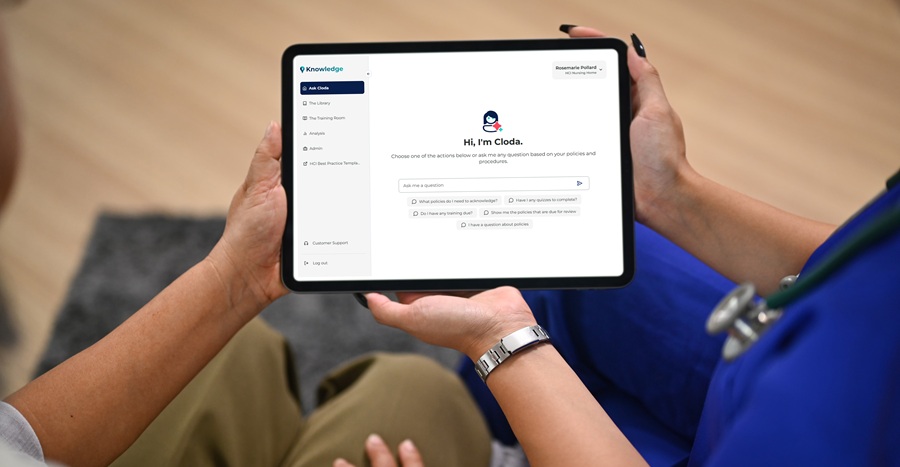
Digital systems like Cloda can play a transformative role in streamlining compliance, supporting staff, and embedding best practice across your service.
Cloda can provide you homecare service with:
- Best Practice Procedures: Cloda comes with over 34 evidence-based policies and procedures tailored specifically for home support, and in line with HSE and best practice requirements. HCI has a dedicated Best Practice Team that ensure all policies and procedures are kept up to date with home support aged-care best practice requirements.
- Just Ask Cloda: Staff can ask Cloda about any care process and she will provide the answers they need directly from your best practice procedures.
- Multilingual Support: Staff can ask Cloda questions in their own language, and she replies in their language.
- Comprehension of Procedures: Cloda offers comprehension quizzes before staff acknowledge policies, helping to ensure understanding, reinforce learning, and strengthen accountability.
- Microlearning Resources: Your Best Practice Policies and Procedures can be converted into podcast enabling staff to learn on the go, perfect for mobile home support teams.
- Demonstratable compliance: Every interaction — from policy updates to staff acknowledgments — is logged digitally. This creates a clear, auditable trail that simplifies compliance reporting for inspections, audits, and regulatory reviews.
With Cloda embedded in your service, you can confidently meet the new regulatory expectations while supporting staff with the tools they need to deliver high-quality, consistent care — every day.
Looking ahead
The direction of travel for homecare in Ireland is clear. Regulation is coming, quality expectations are becoming more formalised, and providers will need to demonstrate stronger governance across all aspects of service delivery. The development of the Health (Amendment) (Home Support Providers) Bill 2025 and HIQA’s draft standards show that home support services are entering a new phase of accountability and oversight.
Against that backdrop, policies and procedures should be viewed as essential enablers of safe, high-quality care. When they are well designed, clearly communicated and properly implemented, they support staff, protect service users and strengthen organisational readiness for inspection and compliance.
For homecare providers, the priority now is not simply to have policies and procedures in place, but to ensure they are practical, current, service-specific and supported by effective governance systems. Services that invest in that work now will be better placed to meet evolving expectations and deliver consistent, person-centred care in the homes of the people they support.
For more information on our homecare policy and procedure bundle or a demo of Cloda contact info@cloda.ai or call 01 629 2559.

Key takeaways
- Home support in Ireland is moving into a more formal regulatory environment, making policy and procedure development a strategic priority.
- Policies and procedures help translate legal, regulatory and best practice expectations into day-to-day care delivery.
- In homecare, they are especially important because staff often work independently across multiple home settings.
- Strong policies support safe, person-centred, consistent and accountable care.
- Key areas include safeguarding, care planning, medication support, recruitment, training, complaints, incident management, lone working and record-keeping.
- Compliance depends not just on having policies, but on implementing, communicating, monitoring and reviewing them effectively.
- Digital tools such as Cloda can help providers manage policy access, version control, acknowledgements, training oversight and best practice templates more efficiently.

Book a Demo (1)
"*" indicates required fields