

Introduction: The Pressure of Regulatory Readiness
Preparing for an inspection from regulatory bodies such as HIQA or MHC, is a constant pressure for health and social care providers. Whether in acute care, residential care, home support, mental health services, or disability services, organisations are expected to demonstrate that quality, safety, and compliance are embedded in daily operations, not just reviewed when an inspection is due.
This is where healthcare quality management software such as Cloda, plays an increasingly important role. By helping organisations manage policies, audits, incidents, risks, training, and compliance activity in one centralised system, it supports a more structured and consistent approach to inspection preparation. Instead of scrambling to gather documents and evidence when an inspection is announced, providers can build systems that support continuous readiness.
Before we dive in, we would love to hear your thoughts below!
Poll: What is the biggest challenge your organisation faces in getting staff to adopt new digital systems?
Cast your vote to see what your peers say!
Why Inspection Readiness Is a Growing Challenge
Healthcare organisations are working in increasingly complex regulatory environments. Leaders are expected to demonstrate strong governance, maintain accurate records, support staff competency, and show evidence of ongoing improvement. At the same time, frontline teams need access to clear and reliable guidance so they can work safely and consistently.
For many providers, this remains a challenge. Policies may be stored across different folders or systems, audit records may be difficult to retrieve quickly, and training evidence may not be easily visible. Even where strong processes exist, disconnected systems can make it harder to demonstrate that compliance is embedded in daily practice.
This is one of the main reasons healthcare providers are investing in healthcare quality management software. A digital system helps create better visibility, stronger control, and faster access to the evidence needed during regulatory inspections.
What Regulators Look For During Inspections
Regulatory inspections focus on much more than whether documentation exists. Inspectors want to see evidence that systems are working in practice. They typically assess areas such as governance, accountability, policy management, risk oversight, staff knowledge, and continuous improvement.
A provider may have well-written procedures in place, but inspectors also want to know whether staff understand those procedures and follow them consistently. They look for signs that the organisation is monitoring performance, learning from incidents, reviewing risks, and acting on identified issues.
This is where healthcare quality management software becomes particularly valuable. It helps organisations not only store information, but also demonstrate that quality and compliance are being actively managed across the service.
The Limitations of Manual and Fragmented Systems
Many organisations still rely on manual processes, shared drives, spreadsheets, paper-based records, or a mix of disconnected tools to manage quality and compliance. While these systems may have evolved over time, they often create risk when inspection day arrives.
Fragmented systems also reduce visibility. Without a centralised view of compliance activity, it becomes harder to track actions, identify trends, or monitor improvement over time. As a result, organisations may end up reacting to problems rather than managing them proactively.
A more effective approach is to use healthcare quality management software to bring these activities together in one system, creating a clearer and more reliable foundation for inspection readiness.

How Healthcare Quality Management Software Supports Inspection Preparation
The value of healthcare quality management software lies in its ability to support both operational control and regulatory readiness. By centralising quality processes, it helps organisations prepare for inspections in a more consistent and less stressful way.
Centralised Document Control
One of the most immediate benefits of healthcare quality management software is the ability to manage policies, procedures, and guidelines (PPGs) in one central location. Instead of relying on shared drives, paper folders, or multiple platforms, organisations can create a single source of truth for critical information.
This makes it easier to manage version control, maintain approval records, and ensure staff are accessing current guidance. During inspections, it also allows organisations to retrieve information quickly and demonstrate stronger control over documentation.
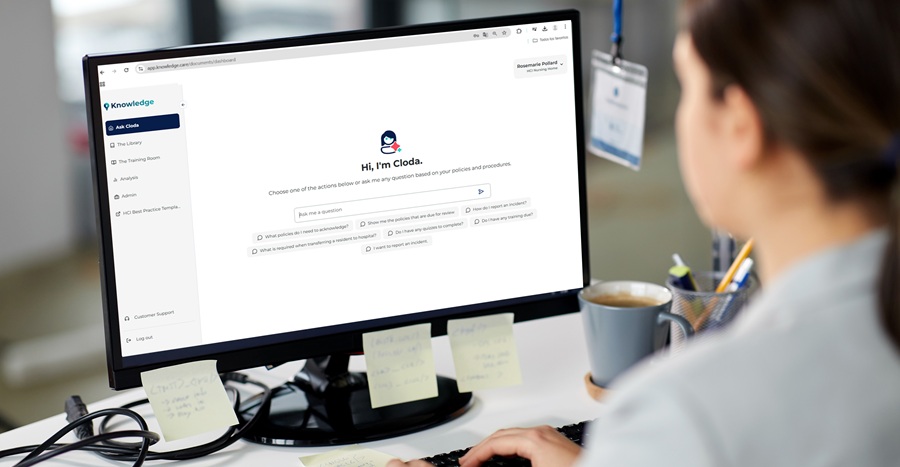
AI enhanced system such as Cloda and The Library go one step further by allowing staff to ask a question and Cloda will instantly provide the answers needed, directly from your organisation’s approved procedures. Comprehension quizzes before document acknowledgement also support staff understanding of procedures and not just passive acknowledgements.
Our data shows that on average staff spend 2.8 seconds acknowledging a policy, however when a quiz is applied this increases to 3 minutes. Highlighting the benefit of having a quiz to ensure staff read and understand your procedures. It also provides you with valuable evidence to demonstrate understanding of procedures when the regulator comes.
Audit and Compliance Tracking
Regulatory inspections often focus on whether organisations can show a clear process for monitoring compliance and responding to issues. In our recent analysis of HIQA Inspection Reports of Disabilities Services, one of the clear themes of the reports was that provider’s own audits had already identified serious issues, but those issues remained unresolved.
Healthcare quality management software supports services by enabling teams to schedule internal audits, track findings, assign actions, and monitor progress over time. Rather than storing audit activity in separate spreadsheets or email chains, everything can be recorded and reviewed in one place. This gives managers better visibility of compliance status across departments or services and helps identify gaps before they escalate. It also provides a stronger evidence base during inspections, showing that quality improvement is ongoing rather than reactive.
Incident and Risk Management
Inspectors also want to see how organisations identify, report, and learn from incidents and risks. Standard 5.8 of the National Standards for Safer Better Healthcare, requires healthcare services to engage in “Proactive identification, documentation, monitoring and analysis of patient safety incidents. Learning from these incidents is communicated internally and externally and used to improve the quality and safety of the service.”
A digital quality management system helps standardise this process by providing a clear framework for reporting concerns, investigating root causes, and documenting corrective or preventive actions.
This creates stronger oversight and makes it easier to demonstrate a culture of learning and accountability. Instead of presenting incidents as isolated events, organisations can show how trends are tracked, lessons are captured, and improvements are implemented. That level of transparency is critical in demonstrating a mature approach to governance and patient safety.
Training and Staff Competency Management
Inspection readiness also depends on staff being trained, competent, and confident in the standards they are expected to follow. This was identified as a gap in HIQA’s Overview Report for Healthcare Services in 2024. They commented that “significant gaps in staff uptake of mandatory and essential training was identified in 34% of healthcare services that were partially or non-compliant with the national standard. Areas where the uptake of training needed to improve included training in standard and transmission-based precautions, hand hygiene, basic life support, early warning systems obstetric emergencies.”
HIQA further noted that…”Senior management awareness and oversight of staff uptake of mandatory and essential training varied across the healthcare services… This awareness was further impacted by difficulties in recording and monitoring staff attendance and uptake of mandatory and essential training centrally.”
Healthcare quality management software such as The Training Room can support services in addressing these concerns by helping managers assign training by job roles, automate renewals, track training completion, monitor competency requirements, and maintain accurate records of staff development. This creates greater visibility over where refresher training may be needed and helps ensure that compliance responsibilities are supported by ongoing learning.
From an inspection perspective, this is a significant advantage. Organisations can show not only that training has been delivered, but that there is a structured approach to maintaining staff knowledge and competence over time. This strengthens assurance for regulators and supports safer, more consistent care in daily practice.
Reporting and Evidence at Your Fingertips
A major challenge during inspections is being able to provide evidence quickly and confidently. Healthcare quality management software supports this by making reports, records, and performance data easier to access in real time.
Whether an inspector is looking for audit outcomes, training records, incident trends, corrective actions, or policy review history of acknowledgement records, a digital system reduces the time and stress involved in gathering that information. It also helps present a more complete picture of quality performance, allowing organisations to demonstrate not just compliance, but progress and continuous improvement.
Supporting a Shift to Continuous Readiness
Taken together, these capabilities help healthcare organisations move away from rushed inspection preparation and toward a more sustainable model of continuous readiness. Instead of trying to gather evidence at the last minute, teams have access to the systems, records, and oversight needed to demonstrate compliance as part of everyday operations.
This shift is important because it changes inspection preparation from an administrative burden into a by-product of good governance. When documentation is controlled, audits are tracked, incidents are reviewed, and staff competencies are monitored in one system, organisations are in a far stronger position to respond to inspections with confidence.
The Role of Cloda: Supporting Staff at the Point of Care
Cloda strengthens the value of healthcare quality management software by providing staff with the answers they need from your policies and procedures, quickly and easily. While the software provides the structure for compliance and governance, Cloda helps staff access and understand your care processes in day-to-day practice.
This is especially valuable in busy healthcare environments, where staff need clear answers in the moment rather than having to search through lengthy documents. It is also highly relevant during regulatory inspections, when organisations must demonstrate not only that policies exist, but that staff can access and apply them confidently in practice.
User engagement is very strong. Our data shows that Cloda achieves a user adoption rate of over 80% within the first six weeks, while 72% of users actively engage in conversations with Cloda. This highlights how quickly Cloda can become part of everyday working life, supporting staff in a practical and accessible way.
Key Cloda features include:
- Instant answers to policy and procedure questions
- Mobile-friendly access for staff working across different care settings
- Multilingual support so staff can ask questions in their own language
- Comprehension quizzes to reinforce learning and understanding
- Real-time support at the point of care
By making policies more accessible and practical, Cloda helps organisations move beyond storing information and toward embedding compliance in everyday work.
Cloda’s Expanding Quality Management System
Cloda’s Quality Management System is also evolving to support a broader range of quality and compliance activities, with new modules designed to strengthen oversight, streamline reporting, and improve organisational visibility.
Upcoming functionality includes incident management, risk management, and internal audit tools, all enhanced by AI-driven support. Modules include:
- The Evaluation Station: Provides audit and compliance oversight in real time, helping governance teams track tasks and demonstrate quality and safety.
- The Events Doorway: Streamlines incident, complaint, and feedback reporting — Just speak to Cloda, no forms needed, for seamless event management and insights.
- The Risk Staircase: A proactive risk management tool that helps identify, monitor, and control risks at every level —guided by Cloda’s intelligent prompts.
Together, these developments show how Cloda can support both frontline staff and leadership teams. By combining easy access to information with intelligent automation, Cloda helps reduce administrative burden, strengthen compliance processes, and support safer, more consistent care.
Conclusion: Strengthening Quality Management in Practice
Effective quality management in healthcare is about more than meeting regulatory requirements. It is about creating the systems, visibility, and staff support needed to deliver safe, consistent, high-quality care every day.
Healthcare quality management software plays a central role in making this possible. By bringing together policies, audits, incidents, risks, training, and reporting, it gives organisations a more structured and proactive way to manage compliance and quality performance. It also helps leadership teams move from reactive administration to more informed oversight and decision-making.
Cloda adds an important practical layer to this approach. By making policies and procedures easier for staff to access, understand, and use in real time, Cloda helps connect quality systems with frontline practice. This supports stronger staff confidence, better policy adherence, and a more embedded culture of compliance.
As Cloda’s quality management capabilities continue to expand, the opportunity becomes even greater. Combining intelligent access to information with tools for audit, incident, and risk management can help organisations strengthen both operational efficiency and quality assurance. For healthcare providers looking to improve compliance, empower staff, and build a more resilient quality framework, this creates a stronger foundation for safer care and better outcomes.
For more information or to book a demo of Cloda, contact info@cloda.ai or call 01 629 2559.

FAQ
What is healthcare quality management software?
Healthcare quality management software is a digital system that helps organisations manage compliance, policies, audits, incidents, risks, training, and quality improvement activities in one place.
How does healthcare quality management software help with inspections?
It supports inspection readiness by centralising records, improving document control, tracking audits and actions, and making compliance evidence easier to access.
Why is staff competency important during regulatory inspections?
Regulators want to see that staff not only have access to policies, but also understand and apply them consistently in practice. Training and competency records help demonstrate this.
How does Cloda support compliance in healthcare?
Cloda helps staff access policy and procedure guidance quickly, in real time, through mobile-friendly and multilingual support, while also reinforcing understanding through quizzes.

Book a Demo (1)
"*" indicates required fields