




Introduction
Governance is the regulatory area providers most often assume is under control. Audits are scheduled, checklists are completed, and dashboards show green. Yet governance and audit failures remain one of the most common reasons services are rated Requires Improvement or Inadequate, often despite those very systems being in place.
To understand why, we reviewed 14 CQC care home assessment reports published in July 2026, each rated Requires Improvement or Inadequate. 100% of these reports had deficits in audit and quality assurance systems.
This isn’t a coincidence, and it isn’t a sign that these providers weren’t trying. Many of the reports describe engaged, hard-working managers and compassionate staff. What they consistently show instead is a structural problem: audits that don’t catch what’s actually happening on the ground, or that catch it but don’t lead to sustained action. The breakdown below groups the specific findings by theme, so providers can benchmark their own systems against the gaps inspectors are repeatedly finding.
Before we dive in, we would love to hear your thoughts below!
Poll: When your last audit flagged a quality improvement plan, was it resolved before the next audit cycle?
Audits Didn’t Identify Problems Inspectors Found on the Day
- Internal audits failed to pick up gaps in care documentation, meal charts, eMAR records, and Mental Capacity Act/DoLS paperwork.
- Audits missed inconsistencies in repositioning charts, fluid and bowel monitoring, and unsafe food consistency.
- No evidence that audit checklists were backed by an actual review of the underlying documents.
- Legionella and fire risk action plans were reported as “complete,” but management couldn’t locate documentation to confirm this.
- Care plans containing generic or missing information were not flagged by existing review processes.
- Communication systems between units and shifts were not checked, leaving staff unaware of hospital admissions, appointments, or changes in care needs.
Audits Reported Compliance That Didn’t Match Reality
- An internal care records audit and a pharmacy audit both reported high or full compliance, while inspectors found significant gaps in care planning, consent, and medicines management during the inspection.
- Medicine management audits failed to identify missing body maps for topical medication application.
- Recruitment audits did not identify missing pre-employment checks or gaps against the provider’s own policy.
- Quality assurance processes did not flag infection prevention and control issues, or medication trolley storage temperatures outside safe range.
Findings Were Identified but Not Followed Through
- Audits flagged concerns, but no action plan was implemented to address them.
- Managers did not maintain ongoing oversight of risks that had already been identified.
- Issues were allowed to persist without timely intervention between audit and resolution.
- Where action plans did exist, they were described as too recent to have resulted in any sustained or embedded improvement.
Ownership and Accountability for Audits Was Unclear
- Staff could not confirm who was responsible for completing medicine audits.
- No clear line of accountability for medicine stock oversight, administration checks, or disposal of expired medication.
- No consistent structure or strategy in place to define who monitored what, or how frequently.
Oversight Relied Too Heavily on Group-Level Systems
- Service-level oversight depended almost entirely on provider-level (group) governance systems rather than local audits.
- Registered managers could not demonstrate independent oversight of their own service, because local audits either weren’t taking place or weren’t being shared back with them.
- Central assurance systems did not provide accurate confirmation of quality or safety at individual service level.
Issues Were Repeated Findings, Not New Ones
- Concerns identified in this assessment had already been flagged at a previous inspection and had still not been resolved.
- Providers were aware of specific shortfalls (e.g. call bell response delays, staff morale, staffing shortfalls) before the inspection but had not resolved them.
- Learning and improvement processes did not prevent the same gaps from being found again on return visits.
- Statutory notifications of significant incidents were not consistently submitted to the CQC, despite this being a legal requirement.
The Common Thread
Taken together, these findings point to the same underlying issue regardless of the specific gap: audit and quality assurance systems were treated as a compliance exercise to be completed, rather than a live tool for managing risk and quality assurance. An audit checklist being signed off was too often mistaken for a genuine review having taken place. Findings, where they were identified, weren’t reliably converted into an owned, tracked, and verified action. And in several cases, oversight sat too far from the point of care to catch problems before an inspector did.
These findings reflects audit management system issues that can’t reliably close the loop between spotting an issue and confirming it’s been resolved. That is the gap regulators are now finding consistently, and it’s the gap most worth addressing before the next inspection, not after.
Where Cloda’s Evaluation Station Fits In
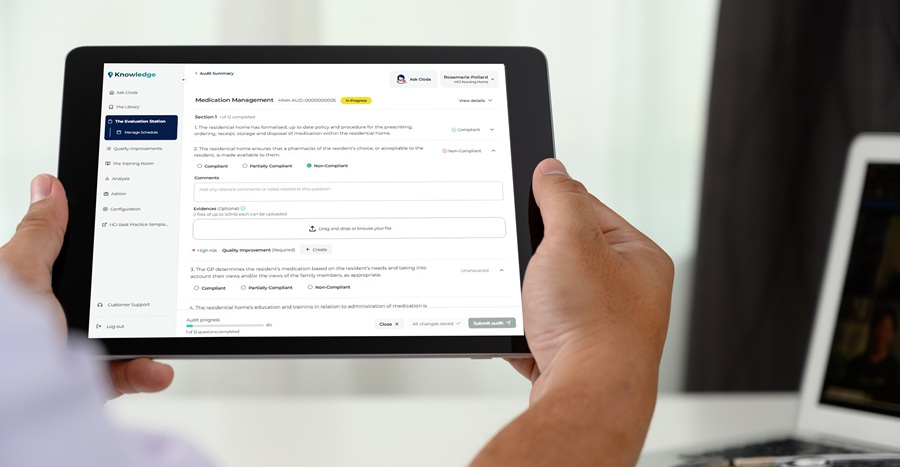
The pattern across all 14 reports isn’t a lack of audits — it’s a broken link between finding an issue and actually closing it. Cloda’s Evaluation Station is built around fixing exactly that gap:
- Easily generates a Quality Improvement Plan (QIP) item when you identify a compliance gap, with a named owner, a deadline, and a status that stays visible until it’s resolved and verified.
- Audit evidence is linked directly to underlying records in real time, so a compliance score reflects what’s actually been reviewed, not just that a form was filled in.
- Oversight sits in one system across every home in a group, giving registered managers the same visibility at service level that group-level leaders have centrally.
- Nothing sits unassigned or falls off a spreadsheet, because ownership is built into the workflow rather than left to informal understanding.
Want to see how The Evaluation Station could close the audit-to-action gap in your care home? Get in touch with the Cloda team.
Book a Demo
For more information or to book a demo of The Evaluation Station, contact info@cloda.ai.

Book a Demo (1)
"*" indicates required fields