




Artificial intelligence (AI) is creating opportunities for social care organisations to reduce administrative workloads, improve access to information and strengthen quality management. However, the real value of AI in social care depends on how effectively it supports the people responsible for delivering and overseeing care.
For care home managers, directors of nursing, quality leads and senior executives, the priority is not simply introducing new technology. It is identifying where AI can make everyday processes more efficient while maintaining professional judgement, accountability and person-centred care.
These questions were explored during the Using AI to Achieve Outstanding Care discussion at Care Show Birmingham 2026. Chaired by Seán Morris, the panel brought together Mason Barendrecht, Steve Sinnott, Louise Cobban and Liz Easthope to discuss the opportunities, challenges and responsibilities associated with adopting AI across social care services.
Their experiences highlight an important principle: AI should help organisations work more effectively, not replace the human expertise that underpins high-quality care.
Poll: Is your social care service currently using AI?
Cast your vote to see what your peers say!
Artificial intelligence (AI) is creating opportunities for social care organisations to reduce administrative workloads, improve access to information and strengthen quality management. However, the real value of AI in social care depends on how effectively it supports the people responsible for delivering and overseeing care.
For care home managers, directors of nursing, quality leads and senior executives, the priority is not simply introducing new technology. It is identifying where AI can make everyday processes more efficient while maintaining professional judgement, accountability and person-centred care.
These questions were explored during the Using AI to Achieve Outstanding Care discussion at Care Show Birmingham 2026. Chaired by Seán Morris, the panel brought together Mason Barendrecht, Steve Sinnott, Louise Cobban and Liz Easthope to discuss the opportunities, challenges and responsibilities associated with adopting AI across social care services.
Their experiences highlight an important principle: AI should help organisations work more effectively, not replace the human expertise that underpins high-quality care.
Where Can AI in Social Care Make the Biggest Difference?
AI in social care can reduce repetitive administration, improve access to approved information and help quality teams identify issues for review.
The most valuable applications of AI address specific operational challenges rather than introducing technology without a clear purpose.
Across residential care, home care and other social care services, teams regularly manage policies, training records, audits, compliance documentation and quality improvement activities. These processes are essential, but fragmented systems and manual workflows can make them unnecessarily time-consuming.
AI-enabled technology can support organisations by making information easier to access, helping structure administrative tasks and highlighting patterns that require management attention.
| Operational challenge | Traditional approach | AI-enabled opportunity |
|---|---|---|
| Policy and procedure access | Staff manually search documents or contact managers | Staff ask questions and receive answers from approved organisational procedures |
| Audit documentation | Auditors manually record and organise findings | AI helps structure observations and draft findings and QIPs for auditor review |
| Quality monitoring | Managers review reports individually to identify trends | AI helps highlight recurring themes for further investigation |
| Policy understanding | Organisations rely on acknowledgement records | Comprehension quizzes help identify where additional learning may be needed |
| Governance oversight | Quality teams consolidate information from separate systems | Digital dashboards and reporting provide clearer visibility of compliance activity |
Not every improvement requires AI. Some challenges can be addressed through better document management, clearer responsibilities or improved digital workflows.
The priority should be selecting the most appropriate solution for the problem, rather than assuming AI is necessary for every process.
How Can AI Reduce Administration Without Replacing Professional Judgement?
AI can reduce time spent on repetitive administrative tasks while preserving the professional analysis, reflection and accountability essential to care.
Administrative responsibilities are a necessary part of social care. Documentation, safeguarding reports, audit records and governance reviews all contribute to safe, accountable services.
However, there is an important difference between reducing unnecessary administration and removing activities that support professional learning.
During the Care Show discussion, Mason Barendrecht emphasised the opportunity for AI to release more time for direct care. Liz Easthope offered a complementary perspective, explaining that completing safeguarding documentation can help professionals develop and maintain their judgement.
Both perspectives are important. AI may help organise information or prepare documentation, but professionals must remain responsible for understanding the evidence and determining appropriate actions.
Which administrative tasks are suitable for AI support?
Potential applications include:
- Retrieving information from approved organisational policies.
- Structuring audit notes and observations.
- Preparing draft summaries for professional review.
- Identifying outstanding quality improvement actions.
- Supporting the organisation of governance information.
- Helping staff prepare routine administrative communications.
For example, an AI-supported audit process might help organise an auditor’s observations and suggest a compliance rating. However, the auditor must still assess the evidence, confirm the rating and approve the final findings.
The objective should be to reduce repetitive work without removing the professional reasoning that makes documentation meaningful.
Organisations should also consider how time saved will be used. Improvements are more valuable when additional capacity supports supervision, staff development, quality monitoring or direct care.
How Can AI Improve Quality Management and Governance in Social Care?
AI can support social care quality management by identifying recurring issues, improving information visibility and helping teams prioritise improvement.
Quality management relies on the ability to identify concerns, investigate their causes and implement meaningful improvements.
Many social care organisations already collect substantial information through audits, complaints, incident reviews, staff feedback and quality assessments. The challenge is often bringing that information together to identify patterns across teams, services or locations.
During the Care Show discussion, Steve Sinnott described using AI to analyse nine months of quality reviews after removing personal information. The resulting themes were then checked by a professional before being used to inform further work.
As described in OneTouch’s summary of the discussion, the example illustrates how AI can support quality analysis while keeping people responsible for validating findings.

Turning quality information into meaningful improvement
Consider a care provider operating several residential services.
Individual audits may identify similar issues across different locations, such as incomplete documentation, inconsistent policy acknowledgement or recurring training needs.
An appropriately governed AI tool could help highlight these patterns, allowing quality managers to investigate whether they represent isolated findings or wider organisational challenges.
However, identifying a pattern is only the beginning. Effective quality management still requires:
- Validation: Confirm that the information is accurate and relevant.
- Investigation: Understand the circumstances and potential causes.
- Action planning: Assign responsibility for appropriate improvements.
- Monitoring: Track progress against agreed actions and deadlines.
- Evaluation: Review whether the changes have produced sustained improvement.
AI-generated insights should be treated as prompts for investigation, not automatic conclusions about service quality.
This distinction is especially important in regulated environments, where providers must demonstrate that governance arrangements lead to meaningful action.
For example, in England, the Care Quality Commission’s Regulation 17: Good Governance requires registered providers to maintain effective systems for assessing, monitoring and improving service quality and safety.
AI can support the information management aspects of these processes, but the responsibility for meeting regulatory requirements remains with the provider.
Organisations outside England must assess their responsibilities against the regulatory frameworks applicable to their services.
What Governance and Safeguards Are Needed When Using AI in Social Care?
Responsible AI adoption requires clear organisational policies, appropriate data protection controls, staff training and human oversight of outputs.
Introducing AI into social care requires more than assessing technical functionality. Organisations must also consider how the technology will be governed, what information it can access and how its outputs will be reviewed.
During the Care Show discussion, Steve Sinnott emphasised that AI should inform accountable professionals rather than make decisions on their behalf.
For care providers, this means establishing clear boundaries around appropriate AI use, particularly when information may influence safeguarding, care delivery or governance decisions.
Establishing a practical AI governance framework
Organisations should define:
- Approved AI tools: Which systems staff are authorised to use.
- Information governance: What data may be entered, accessed or processed.
- Access permissions: Who can use particular tools and information.
- Human oversight: Which outputs require professional checking and approval.
- Accuracy management: How incorrect, incomplete or misleading responses are identified and reported.
- Staff training: How employees learn to use AI safely and recognise its limitations.
- Accountability: Who is responsible for decisions informed by AI-generated information.
Protecting personal and sensitive information is particularly important.
In the UK, organisations processing personal data must comply with applicable data protection law. The Information Commissioner’s Office provides guidance on AI and data protection, including requirements and recommended practices relating to accountability, risk assessment and appropriate safeguards.
Care providers should not enter identifiable resident, service-user or staff information into unapproved AI services. Any proposed use of personal data should be assessed through the organisation’s data protection and information governance arrangements.
AI should support quality management and access to approved information. It must not replace professional judgement, clinical decision-making, safeguarding responsibilities or organisational governance.
How Should Social Care Organisations Introduce AI Successfully?
Successful AI implementation starts with a defined operational problem, involves staff from the beginning and measures outcomes against clear objectives.
Adopting AI effectively requires a practical implementation strategy. The first question should not be which tool to purchase, but which problem the organisation needs to solve.
A care provider may want to reduce the time staff spend searching for procedures. Another may need better visibility of audit findings, while a multi-site organisation may prioritise consistent quality management processes.
Each challenge requires a different approach.
A practical approach to AI implementation
- Identify a priority problem
Select a process where staff experience unnecessary delays, repeated administrative work or difficulty accessing essential information.
- Review existing processes and information
Check that the relevant policies, records and workflows are accurate, current and appropriately governed. AI cannot reliably compensate for poorly managed organisational information.
- Involve the people who use the process
Engage frontline staff, managers, quality teams and relevant information governance personnel. Their experience will help determine whether a proposed solution is practical.
- Start with a controlled pilot
Test the technology within a defined service, department or workflow. Establish who will review outputs, how issues will be escalated and what successful adoption should look like.
- Measure meaningful outcomes
Relevant indicators may include time spent retrieving information, corrections required, staff engagement, policy acknowledgement, audit completion and quality improvement follow-up.
- Review and expand where appropriate
Assess the results, address limitations and determine whether broader implementation would provide organisational value.
This approach helps providers evaluate AI against real operational requirements rather than relying on demonstrations or assumptions about efficiency.
It also supports staff confidence by showing how the technology fits within established professional responsibilities.
How Can Cloda Support AI-Powered Quality Management in Social Care?
Cloda supports social care organisations through AI-powered policy access, structured compliance workflows, training oversight and audit management.
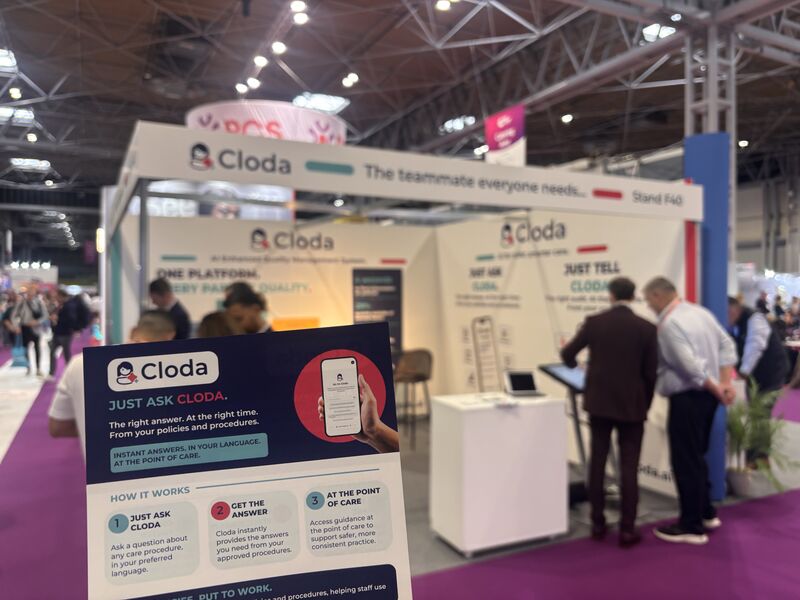
Cloda is an AI-powered Healthcare Quality Management System designed to help healthcare and social care organisations make policies, compliance activities and quality improvement processes easier to manage.
Rather than functioning solely as a document repository or general-purpose AI assistant, Cloda connects approved organisational information with practical quality management workflows.
The Library and Just Ask Cloda: Improving policy access
The Library centralises approved policies and procedures, helping organisations maintain document control and make current guidance accessible to staff.
With Just Ask Cloda, employees can ask questions in everyday language and receive answers based on their organisation’s approved policies and procedures.
For example, a staff member who needs to clarify an internal safeguarding reporting procedure can ask Cloda instead of manually searching through multiple documents.
This supports faster access to organisational guidance while maintaining the need for professional judgement and appropriate escalation.
Cloda also supports policy acknowledgement and comprehension quizzes, helping quality teams monitor engagement and identify where additional explanation or learning may be needed.
The Training Room: Supporting staff development
The Training Room helps organisations schedule training, assign learning activities and monitor completion.
It also supports policy-based microlearning, including podcasts and videos, which can reinforce organisational guidance beyond formal training sessions.
For managers and training leads, these functions provide clearer visibility of training requirements and outstanding activities.
Training completion and policy acknowledgement provide useful evidence of engagement, although neither should be treated as proof of professional competence on its own.
The Evaluation Station: Supporting audits and quality improvement
The Evaluation Station supports the internal audit lifecycle, including scheduling, documenting findings, assigning improvement actions and monitoring progress.
Its Cloda Voice Audits functionality allows auditors to narrate findings while AI helps organise observations, suggest ratings and draft potential Quality Improvement Plans (QIPs).
The auditor remains responsible for reviewing, amending and approving the findings.
Quality improvement actions can be assigned to responsible individuals and monitored through to completion, helping organisations connect audit findings with accountable follow-up.
Together, these capabilities illustrate how AI and structured digital workflows can support both everyday operational needs and wider governance responsibilities.
Conclusion
AI in social care offers meaningful opportunities to reduce unnecessary administration, improve access to information and strengthen quality management. However, its success depends on choosing practical applications, maintaining effective governance and ensuring that professional judgement remains central to care delivery.
For social care leaders, the most valuable approach is to use AI where it can support staff, improve operational consistency and turn quality information into meaningful action.
Cloda helps organisations take this approach by connecting approved policies, staff learning, compliance oversight and audit management within an AI-powered Healthcare Quality Management System.
Book a Demo to explore how Cloda can support your organisation’s quality management, governance and continuous improvement priorities.
Book a demo of Cloda
To explore how Cloda can support continuous quality improvement, compliance management and inspection readiness across your organisation, request a demo.
Key Takeaways
- Start with operational needs: The most effective use of AI in social care addresses specific challenges rather than introducing technology for its own sake.
- Protect professional judgement: AI can assist with documentation and analysis, but accountable professionals must validate important outputs and make decisions.
- Connect insights to improvement: Quality information becomes valuable when findings lead to investigation, assigned actions and measurable follow-up.
- Prioritise governance and adoption: Clear policies, data protection safeguards, staff involvement and training are essential to responsible implementation.
- Use integrated quality management tools: Systems such as Cloda can connect policy access, staff learning, audit management and compliance visibility.
Frequently Asked Questions
What are the main benefits of AI in social care?
AI in social care can help organisations reduce repetitive administration, improve access to approved information and identify quality trends that require attention. These benefits may give managers and staff more capacity for supervision, improvement activities and direct care. Actual outcomes depend on the technology selected, the quality of organisational information and how effectively the system is implemented.
Can AI replace care workers or make safeguarding decisions?
AI should not replace care workers or make safeguarding decisions on behalf of accountable professionals. It can assist with information retrieval, documentation and identifying potential concerns, but these outputs require appropriate human review. Care professionals must continue to apply their judgement, follow organisational safeguarding procedures and escalate concerns through established channels.
How can care homes introduce AI while protecting sensitive information?
Care homes should introduce AI through approved systems supported by clear information governance policies, access controls and staff training. Organisations must assess how personal information is processed, apply relevant data protection requirements and establish appropriate oversight. Staff should also understand why identifiable resident or employee information must not be entered into unauthorised AI tools.
How can AI support audit and inspection readiness?
AI can support inspection readiness by helping teams access relevant policies, organise audit information and identify recurring quality concerns. However, providers must still verify evidence, monitor improvement actions and demonstrate effective governance. AI-generated summaries or suggested ratings should not be treated as confirmed compliance evidence without professional review.
How does Cloda help social care organisations improve quality management?
Cloda supports quality management by combining AI-powered policy access with compliance, training and audit workflows. Staff can use Just Ask Cloda to retrieve guidance from approved procedures, while managers can monitor policy engagement and training activity. The Evaluation Station also supports audit documentation and the tracking of quality improvement actions, helping organisations maintain clearer oversight.
Disclaimer: This article was developed with the assistance of AI tools. All content has been verified using source documents. The content has been reviewed and edited by HCI to ensure accuracy and relevance to the specific context.

Book a Demo (1)
"*" indicates required fields