




The Care Quality Commission has begun a structured pilot and testing programme for its new assessment approach, marking the next step towards a more sector-specific model of regulation.
Published on 4 June 2026, CQC’s latest update confirms that pilots and testing will run from June to October 2026, with a final evaluation planned for November 2026. The regulator says the new assessment approach will be tested before it goes live across all services, with pilot assessments running alongside, not instead of, existing inspections.
Participation is voluntary, and CQC has confirmed there will be no regulatory consequence for providers that choose not to take part. Providers involved in the pilot will receive a pilot report as well as the standard report produced under the current approach, but pilot judgements will have no legal standing and will not affect regulatory status or ratings.
The pilot sample is designed to reflect the diversity of the sectors CQC regulates, covering different service types, sizes, ownership models, geographic locations and risk levels. CQC says the programme will test how the draft approach works in practice across different services and settings, using feedback from participating providers, inspection teams and wider consultation activity to refine the model before wider rollout.
For providers, the message is clear: inspection readiness is becoming less about preparing for a single inspection event and more about being able to demonstrate, at any point, how policies, procedures, governance systems and staff practice connect to quality outcomes.
What is changing in the CQC Assessment Framework?
CQC is moving towards four sector-specific assessment frameworks while keeping the five key questions at the centre of assessment.
The four draft frameworks cover adult social care, mental health care, primary care and community services, and hospitals, secondary and specialist care. The move follows feedback from CQC’s Better regulation, better care consultation, where there was strong support for assessment frameworks that are more specific and relevant to the different sectors CQC regulates.
While the five key questions — Safe, Effective, Caring, Responsive and Well-led — remain, the proposed model introduces a more tailored structure for each sector. The current quality statements are set to be replaced by key lines of enquiry, framed as structured questions that describe what CQC will look for during assessments. New rating characteristics will also describe what Outstanding, Good, Requires Improvement and Inadequate care looks like in each sector.
You can read more about these change in our blog Understanding the Changes to the CQC Single Assessment Framework: What Providers Need to Know.
Why the new CQC assessment framework pilot matters for providers
The pilot matters because it will test whether CQC’s proposed new assessment approach works clearly, consistently and fairly in real services.
The pilot is not simply a technical test of a new inspection template. It is a practical test of how CQC’s new assessment approach works in real services, with real providers and inspection teams.
CQC says the pilots will specifically test whether providers can clearly understand how ratings and judgements have been reached. One of the main criticisms of recent regulatory approaches has been a lack of consistency, clarity and confidence in how judgements are made.
The new approach is intended to support more credible and consistent regulation. For providers, that means the future framework may place greater emphasis on being able to evidence quality clearly, consistently and in a way that connects policies, leadership, staff practice and outcomes for people using services.
What should providers do now?
Providers should use the pilot period to review whether their policies, procedures, training records and governance processes are ready for a more evidence-led assessment model.
Although the new assessment approach is not yet live across all services, providers should not wait until the final framework is confirmed before preparing.
The pilot period gives organisations a useful opportunity to review whether their systems, records and governance processes are ready for a more explicit and evidence-led assessment model.
Practical questions for providers include:
- Are policies and procedures up to date, approved and easy for staff to access?
- Can frontline teams quickly find the right guidance when they need it?
- Are managers confident that staff understand procedures?
- Are training, supervision and policy updates linked clearly to day-to-day practice?
- Can leaders identify uncertainty or knowledge gaps across teams?
- Can multi-site providers demonstrate consistency across locations?
- Is inspection readiness part of everyday governance, rather than a last-minute exercise?
These questions matter because the direction of travel is towards clearer evidence of how quality is understood, delivered and improved. Providers may need to show not only that policies exist, but that staff can access them, understand them and apply them consistently in practice.
From policy documents to evidence-ready practice
Providers may need to show a clearer link between written policies, staff understanding, governance oversight and everyday practice.
For many providers, policies and procedures are already in place. The challenge is whether they are easy to find, easy to use and clearly connected to care delivery.
This gap is already visible in CQC inspection findings. In Cloda’s review of disability care homes rated Requires Improvement or Inadequate, inspectors repeatedly found that providers often had policies, procedures, values or formal processes in place, but frontline care did not always reflect them reliably. The review highlighted concerns across safeguarding, risk management, medicines administration, consent, staffing, dignity and governance, showing that having a policy in place is not the same as embedding it into everyday care.
A policy stored in a folder or digital library may satisfy one part of governance. But if staff cannot quickly access the right information at the point of need, or if leaders cannot see where guidance is being used or misunderstood, there may still be a gap between policy and practice.
CQC’s draft frameworks suggest that providers will need to think carefully about how they evidence this connection.
That means looking beyond documentation alone and asking:
- How do we know staff are using approved guidance?
- How do we identify where teams are unsure?
- How do we communicate policy updates clearly?
- How do we demonstrate learning and improvement?
- How do we give leaders visibility across services, sites and teams?
In a more sector-specific assessment model, evidence will need to reflect the realities of each service type. A care home, a community service, a hospital and a mental health provider will not evidence quality in exactly the same way. But all providers will need to show that their governance systems support safe, consistent and responsive care.
How to Build Everyday Inspection Readiness with Cloda
Cloda helps providers turn approved policies and procedures into accessible, everyday guidance for staff and clearer governance insight for leaders.
As CQC begins piloting its new assessment approach, providers have a timely opportunity to review whether their current systems support everyday inspection readiness.
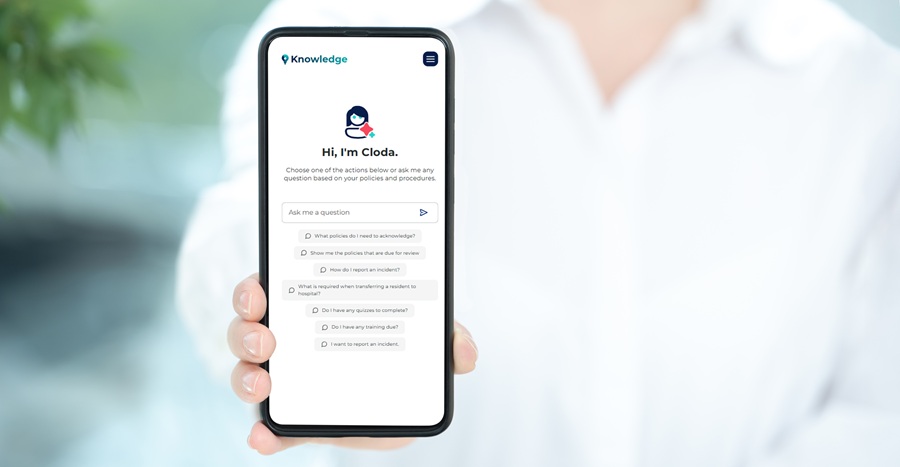
Cloda is an AI-powered Healthcare Quality Management System with a digital assistant that providers frontline staff with instant answers from approved policies and procedures. Instead of searching through documents, staff can ask Cloda questions and receive guidance based on your organisation’s own approved content.
This supports one of the key challenges providers may face under a more evidence-led assessment model: bridging the gap between policy and practice.
For staff, Cloda makes it easier to access the right guidance at the point of care. For leaders, it provides greater visibility of policy engagement, repeated questions and potential knowledge gaps across teams and services. This can help organisations identify where additional communication, training or policy clarification may be needed. It also providers evidence to show CQC that your policies are being utilised in practice.
That visibility is especially valuable for providers operating across multiple sites, teams or service types. Consistency is difficult to evidence if leaders cannot see where variation, uncertainty or low engagement may exist. Cloda’s Compliance Insights help make those signals more visible, supporting stronger governance conversations before issues become inspection findings.
The value is not in replacing human oversight. It is in giving staff clearer access to approved guidance and giving leaders better insight into how that guidance is being used.
What does this mean for quality and governance leaders?
Quality and governance leaders should treat the CQC pilot as a prompt to strengthen everyday evidence, not simply as a regulatory update to monitor.
The most prepared organisations are likely to be those that can show:
- clear ownership of policies and procedures
- accessible guidance for frontline teams
- visible policy acknowledgement and engagement
- evidence of learning from incidents, audits, feedback and complaints
- consistent communication of policy updates
- governance oversight across locations and services
- practical systems for identifying and addressing knowledge gaps
This is not about creating more paperwork. It is about making existing governance more usable, more visible and more connected to practice.
If the new assessment framework places greater emphasis on rating characteristics, key lines of enquiry and clearer evidence of quality, providers will need systems that help them demonstrate how expectations are embedded in daily work.
How should provider prepare for the next phase?
Providers should use the months ahead to review the relevant draft framework, follow CQC updates and strengthen the systems that support inspection readiness.
CQC’s pilot programme will run from June to October 2026, with final evaluation planned for November 2026. During this period, providers should stay close to CQC updates, review the relevant draft sector-specific framework and consider whether their internal systems are ready for the direction of travel.
Cloda can support this preparation by helping staff access instant answers from approved policies and procedures, while giving leaders clearer visibility of policy engagement, repeated questions and potential knowledge gaps. This makes inspection readiness easier to build into everyday governance, rather than treating it as a separate exercise before an inspection.
The key message is simple: inspection readiness should not begin when an inspection is announced. It should be part of everyday quality management.
Providers that strengthen policy access, staff understanding, governance visibility and evidence management now will be better placed to respond with confidence as CQC’s new assessment approach develops.
Preparing for the next phase of CQC assessment? See how Cloda helps healthcare and social care organisations improve policy access, compliance visibility and governance insight.
If you would like to learn more about Cloda or book a demo, contact info@cloda.ai.
Key takeaways
- CQC has begun piloting and testing its new assessment approach, with activity running from June to October 2026 and final evaluation planned for November 2026.
- The pilot will run alongside existing inspections and will not replace the current regulatory process during the testing period.
- Participation is voluntary, and pilot judgements will have no legal standing or impact on a provider’s rating or regulatory status.
- CQC is moving towards sector-specific assessment frameworks for adult social care, mental health care, primary care and community services, and hospitals, secondary and specialist care.
- The five key questions remain: Safe, Effective, Caring, Responsive and Well-led.
- The proposed model replaces current quality statements with key lines of enquiry and introduces rating characteristics to describe what different rating levels look like in each sector.
- Providers should use the pilot period to review policy access, staff understanding, governance visibility and inspection readiness.
- The direction of travel suggests providers will need to show not only that policies exist, but that they are accessible, understood and used consistently in practice.
- Cloda helps healthcare and social care organisations support everyday inspection readiness by giving staff instant answers from approved policies and procedures, while giving leaders Compliance Insights that create visibility of engagement and knowledge gaps.
FAQs
What is the CQC new assessment framework pilot?
The CQC new assessment framework pilot is a structured testing programme for the regulator’s proposed new assessment approach. It is designed to test how the draft sector-specific frameworks work in practice before they are rolled out more widely.
When is the CQC pilot taking place?
CQC has confirmed that pilots and testing will run from June to October 2026, with final evaluation planned for November 2026.
Will the pilot replace existing CQC inspections?
No. Pilot assessments will run alongside existing inspections. The current inspection and regulatory process will continue during the testing period.
Is participation in the CQC pilot mandatory?
No. Participation is voluntary. CQC has said there will be no regulatory consequence for providers that choose not to take part.
Will pilot judgements affect CQC ratings?
No. Providers involved in the pilot will receive a pilot report as well as the standard report produced under the current approach, but pilot judgements will have no legal standing and will not affect regulatory status or ratings.
Which sectors are covered by the draft assessment frameworks?
CQC has published four draft sector-specific assessment frameworks covering adult social care, mental health care, primary care and community services, and hospitals, secondary and specialist care.
Are the five CQC key questions changing?
No. The five key questions remain: Safe, Effective, Caring, Responsive and Well-led. However, the structure beneath those questions is changing, with proposed key lines of enquiry and rating characteristics tailored to each sector.
What are rating characteristics?
Rating characteristics describe what Outstanding, Good, Requires Improvement and Inadequate care looks like in each sector. They are intended to make judgements clearer and more consistent for providers, inspectors and the public.
What should providers do now?
Providers should use the pilot period to review whether their policies, procedures, training records and governance processes are ready for a more evidence-led assessment model. This includes checking whether staff can access approved guidance quickly, whether policy updates are clearly communicated, and whether leaders can identify knowledge gaps across teams and services.
Why does policy access matter under the new CQC approach?
A more evidence-led assessment model means providers may need to show how policies and procedures are understood and applied in practice. It will not be enough to show that a policy exists. Providers should be able to evidence that staff can find the right guidance, use it consistently and escalate concerns where needed.
How can Cloda support CQC inspection readiness?
Cloda provides staff with instant answers from approved policies and procedures. This supports everyday inspection readiness by making guidance easier to access and helping leaders gain visibility of policy engagement, repeated questions and potential knowledge gaps.

Book a Demo (1)
"*" indicates required fields