




What issues did CQC inspectors find with homecare audits?
Inspectors found that audits were failing in one of three ways: they weren’t being carried out at all, they were being carried out but weren’t catching real problems, or they were catching problems that then went nowhere.
Across the 10 reports we reviewed, every service scored Requires Improvement for Well-led, and audit or governance shortfalls were cited in every one. This is not a one-off. It’s a pattern showing up across independent providers, local authority services, and larger multi-branch operators alike.
Before we dive in, we would love to hear your thoughts below!
Poll: When your last audit flagged a quality improvement plan, was it resolved before the next audit cycle?
Why do audits fail to identify real problems?
The most common issue wasn’t the absence of audits, it was that audits existed on paper but didn’t work in practice. Several services had audit schedules covering medicines, care plans, and daily notes, but the audits themselves failed to pick up errors that were sitting in the same records they were meant to review.
Examples from the reports include:
- Medication audits that missed gaps and recording errors on MAR charts.
- Care plan reviews that didn’t identify outdated risk information, including a fluid intake risk that had gone unmonitored.
- Incidents recorded in daily notes that were never escalated for management review.
- A notifiable incident that wasn’t reported to CQC until more than a year after it happened.
One service had a full suite of audits running — care planning, daily records, medicines, health monitoring, environment — but the registered manager never spot-checked the work of the managers actually carrying them out. That single gap in oversight meant serious risks, including self-injurious behaviour incidents, went unmonitored.
Why do some agencies not complete audits at all?
In a smaller number of cases, homecare providers had a quality assurance policy in place but simply weren’t following it. One newly registered service had no formal recorded audits running at all; when auditors created sample audits during the inspection itself, those audits immediately surfaced unrecorded safeguarding concerns, complaints, and incidents. Medicines audits, in particular, were the most frequently skipped — several services could not demonstrate that medication had been administered correctly because no one had checked.
A recurring line from registered managers in these reports was some version of: we know we should be doing this, but we haven’t recorded it, so we can’t prove it happened. Verbal assurance without a paper trail was treated by inspectors as equivalent to the check not having occurred.
What happens when audits find problems but nothing changes?
This was arguably the most revealing failure mode. Several services did run audits that correctly flagged issues, but the finding stopped there. There was no assigned owner, no deadline, and no follow-up review to confirm the issue had actually been resolved.
One local authority-run service had audits that successfully identified areas needing improvement, but action plans lacked completion timescales, named individuals responsible for delivery, or documented sign-off dates. Inspectors noted this meant leaders had no way to track progress or hold anyone accountable for closing the gap.
This is the crux of the problem: an audit that identifies a risk but doesn’t trigger a tracked, owned corrective action isn’t really an audit — it’s a snapshot.
What are the common themes across these audit failures?
Looking across all 10 services together, the individual findings cluster into eight recurring themes.
- No audits carried out at all: Two services had no functioning audit process, despite policy commitments to one. In one case, sample audits created specifically for the inspection immediately surfaced unrecorded safeguarding concerns, complaints, and incidents that had been sitting unnoticed.
- Audits running, but ineffective at catching real issues: This was the largest theme by far, affecting six of the ten services. Audit schedules covering medicines, care plans, daily notes, and the environment were technically in place, but the audits themselves failed to identify the same errors sitting in the records underneath them — including MAR chart mistakes, unescalated incidents, and out-of-date risk assessments.
- Medicines audits singled out as a recurring specific gap: Cutting across several services, medication oversight was the single most frequently cited weak point. This ranged from medicines audits not happening at all despite an internal policy requiring monthly checks, to medicines audits running but failing to catch charting errors and missing information.
- Findings identified but never followed through with action: Perhaps the most instructive theme, because it shows audits working while governance still fails. Several services correctly flagged issues through audits, but no owner, deadline, or follow-up review was attached — so there was no way to confirm, or even track, whether the issue was ever resolved.
- Lack of trend and theme analysis: Distinct from single-incident failures, several services couldn’t demonstrate they were connecting the dots across multiple findings — for example, reviewing incidents involving the same staff member or person without any documented investigation or lessons-learned process.
- Delayed or absent regulatory notification: A downstream consequence of weak governance in a couple of services, including one case where a notifiable incident wasn’t reported to CQC until more than a year after it occurred.
- Poor documentation quality undermining audit reliability: Even where audits were attempted, several services had underlying records too weak to audit against meaningfully — missing signatures and dates, information logged in the wrong sections, or meeting minutes that didn’t match other records held.
- No oversight of the audits themselves: A more structural gap. In more than one service, whoever was meant to check that audits were being done properly wasn’t doing so — for example, a registered manager who never spot-checked the audits completed by managers beneath them, allowing poor practice to go unescalated.
The pattern that stands out most clearly across the matrix is this: only two services had a genuine audit absence. The other eight all had audits running. The failure was almost always in effectiveness, follow-through, or oversight of the audit process itself, not in the existence of a policy or schedule.
How are providers trying to fix this?
Several of the services reviewed pointed to the same broad solution in their improvement plans: moving from manual, paper-based systems to electronic audit and quality assurance platforms. Providers described plans to introduce dedicated quality assurance roles, transition to digital record-keeping, and in one case, begin piloting AI-supported care planning tools.
The direction of travel is consistent. Providers ecognize that spreadsheets, paper trails, and after-the-fact spot checks aren’t sustainable as services grow, and that oversight needs to be built into daily workflow rather than bolted on for inspection.
How does Cloda’s Evaluation Station address these exact gaps?
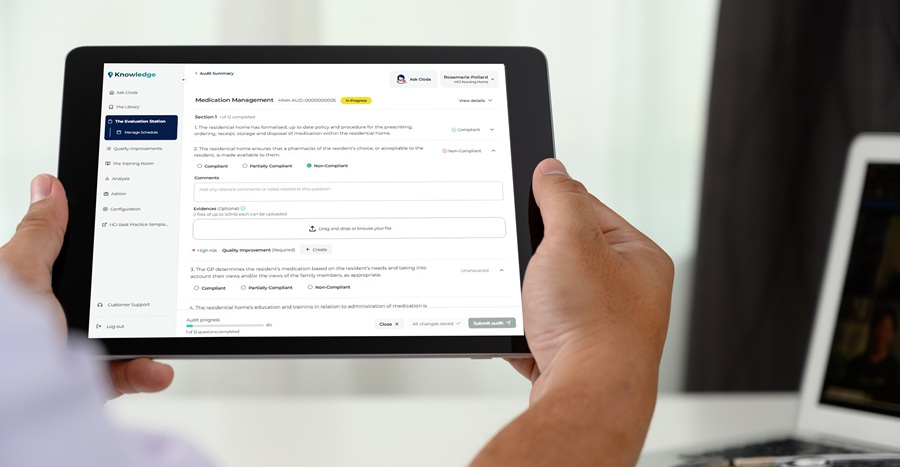
The Evaluation Station is an Audit Management System for health and social care providers, managing the full internal audit lifecycle from scheduling to resolution.
The Evaluation Station was built around the audit lifecycle failure points that show up repeatedly in CQC reports like these. Specifically:
- Every audit finding can generate a QIP directly in the flow of the audit. When an auditor identifies an issue, a Quality Improvement Plan is raised there and then, rather than being noted separately and potentially forgotten.
- QIPs are owned and tracked, not just recorded. Each improvement plan carries an assigned owner and a target date, closing the exact accountability gap inspectors described — no more findings that “went nowhere.”
- The new QIP Analysis function gives managers a live, aggregated view of open, overdue, and closed improvement actions across the service — so gaps in follow-through are visible before an inspector finds them, not after.
- Owner notifications are automated, ensuring the person responsible for an action is alerted, rather than relying on someone remembering to chase it up manually.
To be clear about how it works: audit scheduling itself is set up and managed by the service, and QIPs are raised manually by the auditor at the point they identify an issue. The Evaluation Station removes is the gap between an audit happening and an action being tracked to completion, which is precisely where the providers in this review lost oversight.
The bottom line
None of the providers reviewed here lacked good intentions. Registered managers were consistently described by staff and people using the service as approachable, caring, and responsive. What was missing was a system that turned audit findings into tracked, accountable action — every time, without relying on memory or spreadsheets.
That’s the gap between an audit and a quality management system. Closing it is what keeps a Requires Improvement rating from repeating itself at the next inspection.
Curious how The Evaluation Station‘s QIP Analysis function could support your service’s audit oversight? Get in touch with the Cloda team to see it in action.
Book a Demo
For more information or to book a demo of The Evaluation Station, contact info@cloda.ai.

Book a Demo (1)
"*" indicates required fields