


Poll: Where would real-time compliance insights be most useful in your organisation?
Cast your vote to see what your peers say!
Introduction
Healthcare organisations generate compliance data every day. Every time a staff member opens a policy, searches for a procedure, asks a question, or completes a knowledge check, they create valuable information about how compliance is working in practice.
The challenge is that this data is often underused. For many healthcare providers, compliance is still measured through document acknowledgements, training records, audit preparation, and incident reviews. While these are important, they often show what has already happened.
Compliance data can do more. When used effectively, it can help healthcare leaders identify knowledge gaps, spot high-risk areas, target training, improve policies, and reduce risk before it impacts care.
What are compliance insights in healthcare?
Compliance insights are the practical signals created when staff interact with policies, procedures, training and compliance systems.
Compliance insights in relation to documents include the information generated when staff search for policies, open procedures, ask questions, complete training, acknowledge documents or take quizzes. This data can show which topics are used most often, where staff may lack confidence and which policies may be difficult to understand or apply.
This can include:
- Which policies and procedures staff access most often
- What topics staff search for
- Which questions staff ask repeatedly
- How staff perform in knowledge checks or quizzes
- Which areas show low understanding or confidence
- Where policies may be unclear, outdated, or difficult to apply
- Which teams, departments, or locations may need additional support
In health and social care, the value of this data goes beyond confirming whether a task was completed. It helps leaders answer a more important governance question: do staff understand what they need to do, and can they apply approved procedures safely in practice?
Why do compliance insights matter for risk reduction?
Compliance insights matter because they can reveal early signals of uncertainty before incidents or audit findings occur.
Risk in healthcare does not usually appear without warning. Before an incident, complaint, audit finding, or safeguarding concern, there may already be signals that staff are uncertain, policies are difficult to follow, or training has not been fully understood.
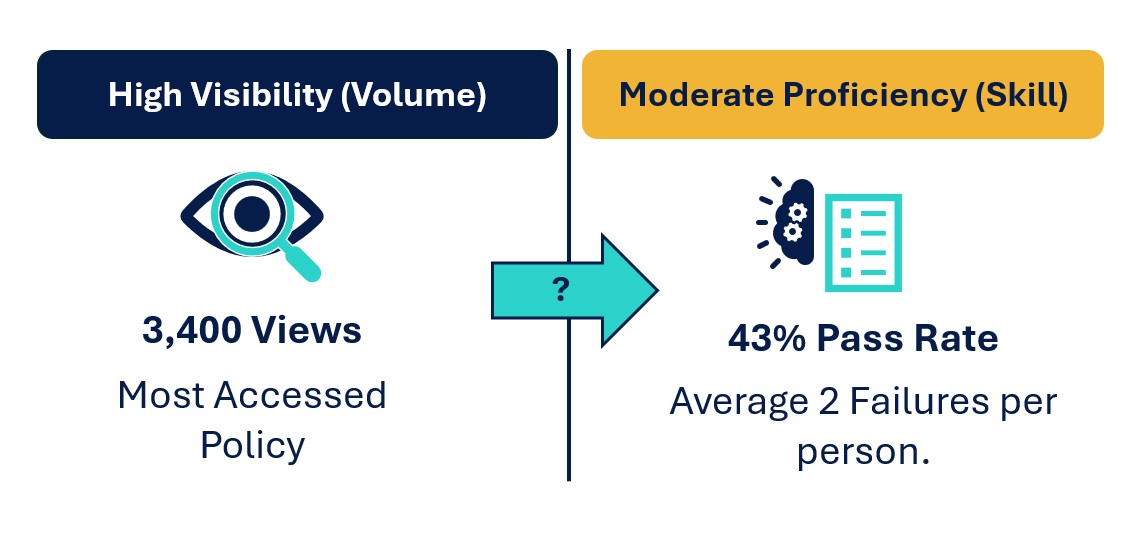
For example, if staff frequently search for guidance on incident reporting, safeguarding, infection prevention, medication management, or transfers of care, this may indicate an area where more support is needed. If a policy is accessed often but quiz results show low understanding, this may suggest that staff are reading the document but not fully grasping the requirements.
If the same questions appear repeatedly, it may mean the policy is unclear, difficult to locate, or not written in a way that supports frontline decision-making.
Cloda’s Compliance Insights help make these signals visible. For leaders, the value is not only in collecting information. The value is in turning those insights into action: clearer policies, better training, stronger oversight and earlier intervention.
How can compliance insights identify knowledge gaps?
Compliance insights help identify knowledge gaps by showing what guidance staff search for, repeat questions or struggle with comprehension checks.
One of the most valuable uses of compliance insights is identifying where staff knowledge may be inconsistent. In healthcare settings, even small gaps in understanding can create risk. Staff may be unsure about escalation steps, documentation requirements, reporting timelines, or the correct procedure to follow in a high-pressure situation.
By analysing policy activity, search behaviour, and quiz performance, organisations can see where staff may need additional support. This allows quality managers, directors of nursing, care managers, and operational leaders to take action earlier. Instead of waiting for an audit or incident to reveal a problem, they can use real-time insight to address the gap.
The goal is not to monitor staff punitively. The goal is to understand where the organisation needs to provide clearer guidance, better training or more accessible procedures.
How can compliance insights improves staff training?
Compliance insights improve staff training by showing which topics need reinforcement and which teams need targeted support.
Training is most effective when it is targeted. Many healthcare organisations deliver mandatory training on a set schedule, but this does not always reflect what staff need most at a specific point in time.
Cloda’s Compliance Insights can show which topics are causing difficulty, which procedures are being searched most often, and which quiz areas have lower pass rates or lower confidence.
This helps managers focus training where it will have the greatest impact. For example, if staff are regularly searching for safeguarding procedures or struggling with questions about incident escalation, this may indicate a need for focused refresher training. If a particular team shows lower understanding of infection control procedures, support can be directed to that team quickly.
This makes training more relevant, more timely, and more connected to day-to-day care delivery. It also helps training teams move beyond completion records. Instead of only asking whether training was delivered, they can ask whether staff knowledge is improving and whether the organisation is reducing uncertainty in higher-risk areas.
How can compliance data supports policy improvement?
Compliance insights support policy improvement by showing which policies are hard to find, unclear or misunderstood.
Compliance insights do not only reveal staff training needs. It can also show where policies and procedures may need to be improved. A policy may be technically correct but still difficult for staff to use. It may be too long, too complex, hard to find, or unclear in the moments when staff need quick guidance.
When staff repeatedly search for the same topic, ask similar questions, or perform poorly on related knowledge checks, this may suggest that the policy itself needs attention.
By using Cloda’s Compliance Insights, organisations can identify which policies should be reviewed, simplified, updated, or made more accessible. This supports a more practical approach to policy management. Policies become living documents that reflect frontline needs, rather than static documents that are only reviewed on a fixed schedule.
The important point is that compliance data should not be interpreted in isolation. High policy access may be positive if it shows that staff are using approved guidance. The value comes from looking at patterns across policy access, questions, knowledge checks, acknowledgements, training and operational context.
How Cloda’s Compliance Insights turns data into action
Cloda’s Compliance Insights turns everyday staff document activity into practical intelligence for quality, compliance and governance teams.
Cloda analyses how staff use policies, what they search for, and how they perform in knowledge checks. These insights help leaders understand where compliance is strong, where staff may need support, and where risk may be developing.
With Cloda’s Compliance Insights, organisations can identify:
- Knowledge gaps across key policy and procedure areas
- High-risk topics that may require urgent attention
- Training needs based on real staff activity
- Policies that may be unclear, underused, or difficult to understand
- Trends that show where risk may be building over time
This gives management teams a clearer view of compliance in practice. For example, Cloda can help leaders see when a high-risk topic is being searched repeatedly, when staff confidence is lower in a specific policy area, or when a policy may need to be simplified because the same questions keep appearing.
Instead of relying only on policy acknowledgements or retrospective audits, organisations can use Cloda to understand how staff are engaging with policies and procedures every day.
What are the benefits of using compliance insights in healthcare?
Using compliance insights helps organisations act earlier, train more effectively and improve governance visibility.
Using compliance insights effectively can help healthcare organisations reduce risk and improve quality in several ways. It supports earlier intervention by highlighting potential issues before they lead to incidents. It helps managers prioritise training based on evidence rather than assumptions. It improves policy quality by showing where staff may be struggling to understand or apply guidance.
It also strengthens governance by giving leaders a clearer picture of organisational compliance. For frontline staff, this means better support, clearer guidance, and more confidence in their daily practice. For management teams, it means better visibility, stronger decision-making, and a more proactive approach to safety and compliance.
Moving from compliance tracking to compliance intelligence
Compliance intelligence goes beyond task completion to show what staff know, where they are unsure and where risk may emerge.
Traditional compliance tracking focuses on whether staff have completed a task. Compliance intelligence goes further.
It helps organisations understand what staff know, what they are unsure about, and where risk may be emerging. This is especially important in healthcare, where safe care depends on staff being able to access, understand, and apply the right information at the right time.
Cloda’s Compliance Insights helps organisations move from simply tracking compliance to truly understanding it. By turning policy activity, search behaviour, and quiz results into actionable insight, Cloda helps healthcare providers identify risks earlier, target training more effectively, improve policies, and support safer care.
This is where an AI-powered Healthcare Quality Management System creates value beyond a traditional policy library. A policy library stores documents. Cloda helps staff use approved guidance and helps leaders understand how compliance is working in practice.
Conclusion
Compliance insights are one of the most valuable tools healthcare organisations have for reducing risk and improving quality. When used well, it can reveal knowledge gaps, highlight high-risk areas, guide training, and show where policies need to be updated or improved.
Cloda’s Compliance Insights makes this data easier to understand and act on.
For healthcare leaders, this means stronger governance, more confident staff, and better protection for the people in their care. Cloda’s Compliance Insights helps organisations move beyond compliance tracking — towards safer, smarter, and more proactive care.
Book a demo to see how Cloda’s Compliance Insights helps healthcare organisations identify knowledge gaps, improve policy access and act earlier on compliance risk.
Contact info@cloda.ai or call 01 629 2559.
Key takeaways
- Compliance insights help healthcare leaders identify knowledge gaps, unclear policies and emerging risk earlier.
- Policy searches, repeated questions, knowledge checks and acknowledgements can all reveal how compliance works in practice.
- Cloda’s Compliance Insights helps turn everyday staff activity into governance intelligence.
- Strong compliance intelligence supports targeted training, better policy management and improved inspection readiness.
- Cloda supports quality management and policy access, but does not replace professional judgement or organisational governance.
Frequently Asked Questions
What are compliance insights in healthcare?
Compliance insights are the practical signals created when staff interact with policies, procedures, training content, acknowledgements, knowledge checks and compliance systems. They help organisations understand whether staff can find, understand and apply approved guidance in practice.
How do compliance insights reduce risk?
Compliance insights reduce risk by showing where staff may be uncertain, where policies may be unclear and where training may need reinforcement. This allows leaders to act before issues appear in incidents, complaints, audits or inspections.
How does Cloda’s Compliance Insights help healthcare organisations?
Cloda’s Compliance Insights helps organisations analyse policy usage, staff questions and knowledge check performance. It gives leaders clearer visibility into knowledge gaps, training needs, policy issues and emerging compliance risks.

Book a Demo (1)
"*" indicates required fields