




Introduction
HIQA inspection reports for designated centres for older people, published in October 2026, show the same weaknesses recurring across nursing homes: governance that doesn’t catch risk, care plans that don’t guide care, and policies that exist on paper but not in practice.
In HCI’s recent webinar, Inspection-Ready or Inspection Risk? Lessons From HIQA’s Latest Reports for Nursing Homes, HCI Best Practice Specialist Rebecca McAuley reviewed these reports and analysed the key areas of non-compliance and substantial compliance under the Regulations.
This blog summarises the main findings under each of the most frequently cited regulations, what providers should do now, and how Cloda can help.
Before we dive in, we would love to hear your thoughts below!
Poll: What’s the biggest obstacle to ensuring staff comply with policies and procedures in your organisation?
Cast your vote and see what your peers say!
Changes Within the Sector
On 18 August 2026, HIQA announced a review of the National Standards for Residential Care Settings for Older People in Ireland (2016). The review reflects significant changes since 2016, including legislative reform, larger residential settings, the impact of COVID-19, and digital transformation, including the EU AI Act 2024. Several key HSE and AMRIC guidance documents were also updated between August and November 2026, covering respiratory outbreak management, community IPC, flu and COVID-19 vaccination, antivirals, scabies outbreaks, infection control in buildings and CCTV.
Red Flags Appearing Across Inspections
Our analysis identified nine regulations rated as non-compliant — and rated red, meaning high risk — across the reports reviewed.
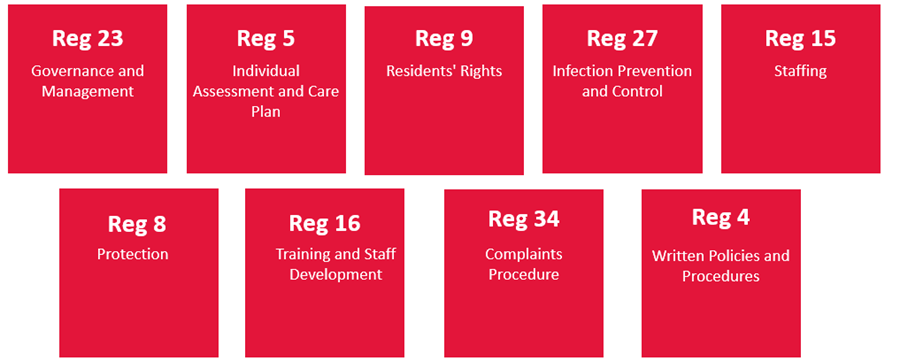
Summary of Findings
Regulation 23: Governance and Management
Unclear management structure and leadership
- A poorly defined organisational structure undermined the systems needed to ensure the service was safe, consistent and appropriately monitored, with ineffective oversight of risk management, infection prevention and control, residents’ clinical care needs and complaints.
- Governance meetings were infrequent, and key risks such as safeguarding concerns were not discussed, escalated or actioned.
- During a change in management there was no structured handover or induction for newly appointed managers, and staff and residents were unclear who the person in charge was.
- An interim Director of Nursing was in post, but no person in charge met the requirements of the regulation, and clinical nurse managers had no allocated time to support clinical leadership.
Audits not identifying risks or driving improvement
- IPC and environmental audits did not identify risks found by inspectors, including some requiring immediate action on infection control and fire safety. Audits missed unlabelled shower sponges in shared bathrooms, damaged guttering causing a slip hazard, and resident areas without a call bell.
- Actions from manager walkarounds had been open since April 2026 with no evidence of review, and audits were completed without an action plan to drive quality improvement.
- Care plan audits missed deficits, including no care plan for a resident at high risk of absconding.
- A high number of falls were not trended, some falls data was incorrect, and no action was taken on an increase in falls. Neurological observations were not recorded after three unwitnessed falls.
Incident and risk management
- Incidents were documented as reported to the PIC, but the PIC said they had not been told. Investigations and action plans were not recorded in the electronic record system.
- Known risks were not assessed, recorded or managed, workforce-related risks were not assessed, and there was no clear pathway for escalating risk from the management team to the provider.
Regulation 5: Individual Assessment and Care Plan
- No appropriate care plan for a resident with significant weight loss and deteriorating health, and no care plans for short-stay residents.
- Two care plans for residents at high risk of pressure ulcers did not include preventative measures, such as air mattress settings or repositioning frequency.
- Care plans were not updated for residents with signs and symptoms of infection, after a significant decline in oral intake, or after incidents of responsive behaviour.
- There was no recorded consultation with residents or families in any of the seven care plan reviews examined.
- The same resident’s name appeared on three care plans belonging to different residents.
- Safeguarding care plans did not clearly identify the risk or control measures, were a record of incidents rather than a plan, or had not been developed following a safeguarding incident.
Regulation 9: Residents’ Rights
- Privacy was not protected in shared bedrooms, toilet doors were difficult to close or left open, and staff were observed entering a resident’s bedroom without knocking on four occasions.
- Activity records showed periods of up to seven days with no documented activity.
- Residents were relocated from single to multi-occupancy rooms without appropriate consultation.
- Residents were not given the information needed to make informed choices, for example about a laundry service already included in their Fair Deal fee, and were not supported to access their finances.
Regulation 27: Infection Prevention and Control
- During an outbreak there was no active surveillance of residents and staff, no accurate line listing, and staff were not aware of outbreak control measures.
- Sharps containers were overfilled, undated or accessible to residents, and needles lacked safety devices.
- Single-use hand rub and soap cartridges were topped up from larger containers, and hand gel was not available at the point of care.
- Equipment labelled as clean was visibly unclean, soiled linen was pre-soaked rather than placed into an alginate bag, and urinals were emptied and cleaned in residents’ sinks.
- Shared and unmarked toiletries, and residents’ incontinence wear, were stored in shared bathrooms.
Regulation 15: Staffing
- Staffing levels and skill mix were not sufficient for residents’ assessed needs or the size and layout of the centre.
- After 8pm, with nurses on medication rounds, one healthcare assistant could not assist approximately 20 high to maximum dependency residents and also supervise communal areas. On one night shift, one nurse and one carer were on duty for 23 residents.
- Rosters showed a weekly deficit of 2.5 WTE nursing staff and 1.5 WTE care staff, covered by high levels of agency staff.
- Leave was not replaced in housekeeping and laundry, with at times only one housekeeping staff member on duty instead of three over a two-week period.
- Residents reported delays in care, personal care was rushed, and staff were observed cleaning the kitchen while residents called out for assistance.
Regulation 8: Protection
- A resident’s allegation that a staff member was rough with them was not reported or managed in line with the regulations.
- Allegations of neglect, missing clothing and money, and a complaint about wound care and weight loss were not recognised or investigated as safeguarding concerns.
- Residents who required enhanced supervision did not consistently receive it.
- Four staff started work before their Garda vetting disclosure was received.
- Residents were charged twice for laundry, charged for routine GP reviews without clinical need, and medical card holders were overcharged for the prescription levy.
Regulation 16: Training and Staff Development
- In one centre, 33 staff had no IPC training, eight had no safeguarding training and three had no fire safety training.
- New staff had no mandatory training, including people moving and handling, and poor moving and handling practices were observed.
- There was no training in managing responsive behaviours, although more than three quarters of residents had dementia or a cognitive impairment.
- Supervision was inadequate, there was no oversight of referrals or clinical documentation, and nursing care records did not reflect the care provided.
- At mealtimes, staff stood over residents while assisting them, two residents were left asleep in the dining room an hour after their meal, and a meal tray was placed in front of a resident lying supine.
Regulation 34: Complaints Procedure
- Displayed complaints procedures lacked advocacy details and response time-frames, or were unclear on who to contact.
- A complaint was not responded to within the regulatory time-frame, and another was closed by an assistant director of nursing not trained in complaints, with no input from the complaints officer.
- Written responses lacked the outcome, learnings, review procedure or Ombudsman information.
- Unresolved complaints were not referred to the Complaints Review Officer.
- Complaints actioned by management were not recorded, and residents’ dissatisfaction with food quality at resident meetings was not treated as a complaint.
Regulation 4: Written Policies and Procedures
- Policies on safeguarding, risk management, records management, incidents, staff training, prevention of abuse, complaints and infection control were not adopted or implemented in practice.
- Five policies were out of date.
- Recruitment and safeguarding policies were not followed, including a safeguarding investigation with no named investigation team, specialist expertise or consultation with senior management.

What providers should do now
The common thread across these findings is that systems existed, but did not work in practice. Audits were completed but missed risks. Policies were written but not followed. Incidents were logged but not investigated. These steps target that gap.
- Confirm your management structure. Make sure you have a person in charge who meets the regulation, clear lines of authority and accountability, and a structured handover and induction for any new or interim manager.
- Hold regular governance meetings. Discuss, escalate and action key risks, including safeguarding concerns, and document the escalation pathway from management to the provider.
- Test whether your audits find what an inspector would. Every audit should lead to an action plan with a named owner, a deadline and evidence of review. Trend falls and other incidents and act on what the data shows.
- Review your risk register. Assess and record known risks, including workforce risks, with controls, owners and review dates.
- Audit your care plans. Check they are person-centred, updated after changes in a resident’s condition or an incident, include safeguarding plans where needed, and record consultation with residents and families.
- Treat every allegation as a potential safeguarding concern. Investigate in line with your policy, confirm Garda vetting is in place before anyone starts work, and check resident charges for accuracy.
- Close training gaps. Review your training matrix for mandatory training, including IPC, safeguarding, fire safety, moving and handling, responsive behaviours and complaints management for managers.
- Check your IPC practice against the latest guidance. Review outbreak management, sharps, hand hygiene, linen and equipment cleaning against the updated HSE and AMRIC guidance.
- Review staffing against assessed needs. Pay particular attention to twilight and night-time cover, leave replacement and reliance on agency staff.
- Bring your complaints process into line with the regulations. Record all complaints, respond within the time-frame, and include the outcome, learnings, review procedure and Ombudsman information.
- Make sure policies are current and in use. Review out-of-date policies and check that staff know and follow them.
How Cloda Supports Compliance
Cloda is HCI’s AI-powered Quality Management System, a digital teammate that supports nursing home staff at the point of care. Cloda helps close the gap between having policies and training on paper and making them work in practice.
With 70+ best practice policy and procedure templates for nursing homes, kept current by HCI’s Best Practice Team, Cloda gives staff instant access to the answers they need from your own policies, whether that’s how to manage an infection outbreak, what to do before transferring a resident to hospital, or which policies are due for review.
Comprehension quizzes confirm genuine understanding, not just acknowledgements. And when HIQA asks whether your staff know what your policies say, you’ll have the evidence to show they do.
Cloda’s expanding QMS includes AI-enhanced funtionality including:
- The Library provides a suite of best practice policies and procedures. It addresses Regulation 4 findings, where policies existed but were not known, followed or kept up to date.
- The Training Room brings staff training records together in one place, supporting providers to address the mandatory training gaps HIQA found under Regulation 16.
- The Evaluation Station brings audits and quality improvement plans (QIPs) together in one place, so audit findings lead to actions with owners rather than sitting open. With Voice Audits, the auditor narrates their findings, Cloda maps them to the audit questions and suggests a compliance rating, and QIPs are drafted for the auditor to review and confirm. By internal HCI estimate, a Voice Audit takes about a third of the time of a manual audit.
- Risk Management helps you identify, assess and manage organisational risks on one register, with AI-assisted controls, owners and review dates. Its analysis function gives providers oversight of all risks, supporting the escalation and oversight HIQA found missing under Regulation 23.
HIQA’s latest reports show that inspection readiness depends on systems that work every day, not only on inspection day.
To see how Cloda can support your nursing home or to book a demo of Cloda, contact info@cloda.ai or call 01 629 2559.
Watch the Full Webinar
The full recording of HIQA’s Red Flags for Nursing Homes: Patterns From The Latest Inspections is now available.

Book a Demo (1)
"*" indicates required fields