



Introduction
Healthcare services face many types of risk, including service and care provision risks, health and safety risks, corporate risks, and risks to individual service users. Risk management therefore plays a central role in patient safety, regulatory compliance and the overall quality of care. An effective risk management framework is continuous, both proactive and responsive, and covers the identification, assessment, management and ongoing review of risk at organisational and individual level.
The risk register is the tool that brings this together. In 2023, the HSE published its Enterprise Risk Management Policy and Procedures, which replaced the HSE Integrated Risk Management Policy 2017 and is aligned with ISO 31000:2018 (HSE, 2023). In this post, we set out what to include in a healthcare risk register under the current HSE guidance, how to keep it up to date, and the benefits of using an electronic risk register.
Poll: What's the biggest challenge in keeping your risk register up to date?
Cast your vote to see what your peers say!
What is a Healthcare Risk Register?
A risk register is a database of the assessed risks an organisation faces at any one time. It changes constantly to reflect both the risks themselves and how the organisation is managing them. Its purpose is to help managers prioritise resources to minimise risk and target improvements where they will have the most effect.
The HSE compares the risk register to the performance and financial reports managers already rely on. It brings together, in summary form, the essential information on every risk being managed. Because ratings are tracked over time, it also shows whether each risk is going up or down.
The HSE is clear that having a register is not the goal of risk management in itself. The register should be used to inform management decisions, plans and actions (HSE, 2023).
What to Include in a Healthcare Risk Register
For each risk, the HSE expects the register to record a clear description, the controls in place, the additional actions needed to reduce it further, and its current rating (HSE, 2023). In practice, a well-built register entry includes:
- Risk classification: a name or ID number, the type of risk (organisation-wide or departmental), its category (clinical, health and safety, corporate, care provision and so on), the department it relates to, and its source (incident, complaint, staff concern, audit and so on).
- Description of the risk: a clear, concise statement of the risk and who or what it affects.
- Risk Owner: the person accountable for making sure the risk is managed, normally the manager of the service where the risk sits (HSE, 2023).
- Likelihood, impact and risk rating: likelihood is multiplied by impact to give a risk score, plotted on a 5 x 5 matrix and rated High, Medium or Low (HSE, 2023). The HSE Risk Assessment Tool, included in Appendix 2 of the 2023 policy, sets out the likelihood and impact scales. Ranking risks by rating highlights the highest priorities for those accountable for the service.
- Existing controls: the measures already in place to reduce the likelihood or impact of the risk. Controls may be preventive, responsive or supportive.
- Additional actions: the further actions needed to bring the risk to an acceptable level. Each action should have an Action Owner and an agreed completion date (HSE, 2023).
- Risk status: Open, Monitor or Closed (see below).
- Risk log: a record of updates, actions completed and changes in rating over time, showing how the risk has been managed across its life cycle.
Keeping the Risk Register Live
A register is only useful if it is kept current. Risks on the register must be monitored on an ongoing basis by the Risk Owner and the relevant Management Team to make sure the required actions are completed (HSE, 2023).
How often should the register be reviewed?
Review | Frequency (HSE, 2023) |
|---|---|
Register at Management Team meetings | Monthly recommended, quarterly at minimum |
Risks with Monitor status | At least quarterly, or sooner if controls aren’t working |
The whole register | At least twice a year, ideally at a dedicated risk meeting |
The HSE also suggests adding “risk management/register” as a standing agenda item at team meetings. This helps build risk management into day-to-day practice rather than treating it as a separate function (HSE, 2023).
Risk status: Open, Monitor and Closed
- Open: the risk is under active management, with additional controls still to be put in place.
- Monitor: the risk is recognised, but no further action is needed for now.
- Closed: all required actions are complete and the risk is within the desired level. Closed risks are archived to a Closed Register for audit purposes and reviewed periodically to make sure controls still work.
New risks are entered as Open or Monitor. Where controls stop working as intended, the risk rating should be reassessed (HSE, 2023).
Benefits of a Digital Risk Register: Cloda’s Risk Management Module
Risk management should be built into existing work practices and oversight, so that services develop a risk management culture rather than a standalone risk function. A digital risk register makes that easier, because staff and managers can raise, review and act on risks in the same place they already work.
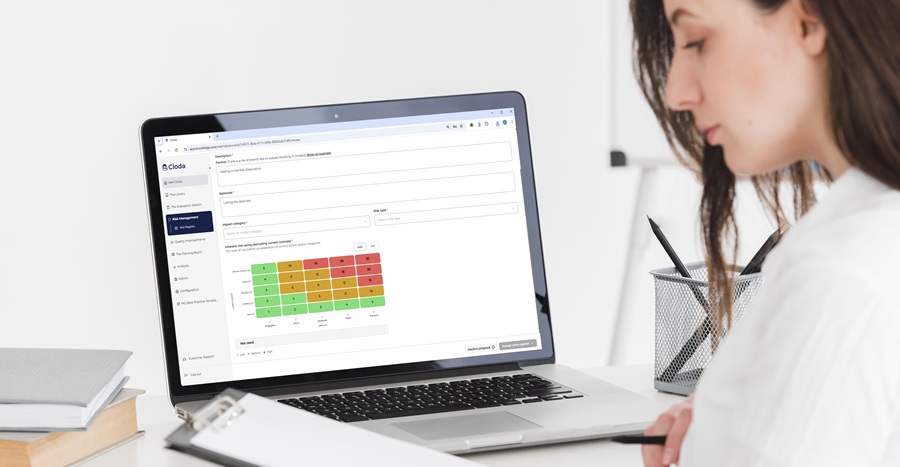
Cloda’s Risk Management module brings risk identification, assessment and action tracking together in one system, supporting the process the HSE sets out from the first report of a risk through to its review.
Make risk reporting everyone’s responsibility
Any staff member can propose a potential risk by entering a short description and explaining why it matters. The proposal goes to the designated Risk Owner for review, and staff can follow its progress through the risk management module.
One central risk register
Risks across the organisation are recorded in a single register, giving managers clear visibility of each risk, its rating and the progress being made.
AI-assisted control suggestions
When a risk is proposed, Cloda reviews relevant organisational policies, training records and audits to suggest existing controls, with supporting evidence for each. Cloda acts as an assistant here, not a decision-maker. The Risk Owner reviews each suggestion, accepts or rejects it, decides the risk rating and assigns any further actions.
Structured risk assessment
Risk Owners can accept or decline proposed risks, assess the existing controls, and rate the remaining risk to help prioritise action.
Actions with clear accountability
Additional control measures can be assigned to named staff with defined responsibilities and target completion dates. Action Owners see what they need to do and by when through Quality Improvements, and record their response once complete. This reflects the HSE expectation that every action has an owner and an agreed completion date.
Oversight of your risk profile
Managers can view the organisation’s risk profile, monitor new risks and changes to existing ones, and identify priority risks and outstanding actions that need attention. This supports the regular Management Team review the HSE requires.
By keeping a documented record of risks, assessments, controls and actions, Cloda also helps services show how they manage risk when preparing for inspection by HIQA or the Mental Health Commission, where relevant.
Conclusion
A risk register is one of the most important tools for managing risk across a healthcare service, but only if it is kept live. Under the HSE’s 2023 policy, that means clear entries with named Risk Owners, ratings on the High, Medium and Low scale, the correct Open, Monitor or Closed status, and regular review by the Management Team.
Cloda’s Risk Management module and electronic Risk Register helps you identify, assess, manage and monitor significant risks in one place, so you can spot emerging issues early and focus on the controls that support safe care.
Request a Demo to see Cloda in action.
Contact info@cloda.ai or call +353 (0)1 629 2559.
Disclaimer: This article was developed with the assistance of AI tools. All content has been verified using source documents. The content has been reviewed and edited by HCI to ensure accuracy and relevance to the specific context.

Book a Demo (1)
"*" indicates required fields