



Introduction
Most healthcare providers can tell you who has completed their mandatory training. Far fewer can tell you who understood it, who is about to fall out of compliance, or where the next incident is likely to come from. That gap is where training compliance analytics comes in — and it’s the difference between running a training system and running a governance function.
This isn’t a hypothetical problem. HIQA’s overview report on the monitoring and regulation of healthcare services in 2024 identified oversight of, and attendance at, mandatory education and training as a recurring area for improvement. For organisations managing staff training compliance in healthcare settings across multiple departments or sites, the administrative burden of chasing that evidence manually — rather than having it visible in one place — is often exactly where these gaps take hold.
Before we dive in, we would love to hear your thoughts below!
Poll: Which feature do you think has the biggest impact on effective healthcare training?
Cast your vote and see what matters to your peers!
Why is education and training important in healthcare?
Education and training is important in healthcare because it directly determines whether staff have the knowledge and skills to deliver safe, high-quality care in line with regulatory requirements.
Mandatory training isn’t a compliance formality — it’s how healthcare organisations ensure staff are equipped to manage risk, respond correctly in emergencies, follow safeguarding procedures, and deliver care consistently across every shift, department and site. Regulators treat it accordingly: both HIQA and CQC expect providers to demonstrate not just that training has taken place, but that it is current, relevant to each role, and properly recorded. Gaps in training oversight are consistently flagged as inspection findings because they point to a wider governance issue — an organisation that cannot show what training has and hasn’t happened cannot fully assure the quality and safety of the care it provides.
That’s why training compliance can’t be treated as a one-off administrative task. It needs to be tracked and reviewed continuously, in the same way clinical risk or incident data is.
What is training compliance analytics?
Training compliance analytics is the practice of analysing training data — completion, expiry, role relevance and retraining needs — to identify compliance risk before it becomes an inspection finding.
Rather than simply confirming that a course was assigned and finished, training compliance analytics asks harder questions: Is this training still valid? Was it relevant to this person’s role? Is there a pattern of overdue or lapsed training across a team, department or site that points to a bigger governance issue?
This is the layer that sits above training delivery. An LMS gets people through courses. Training compliance analytics tells governance and quality teams what that completion data actually means for risk.
Why is completion data not enough?
Completion data on its own is not enough because “completed” only confirms a single moment in time — it says nothing about whether that training is still valid, or whether every relevant staff member has done it.
A full training compliance picture needs to track staff through every stage:
- Assigned – the training has been allocated to the right role
- Completed – the staff member has finished the course
- Expired – the certification or refresher window has lapsed
- Understood – the staff member has demonstrated comprehension, typically through a knowledge check
- Applied – the learning is reflected in practice, behaviour or documented competence
- Evidenced – there is a defensible audit trail linking all of the above together.
A provider can have a high completion rate on paper and still carry significant compliance risk if expiry dates are being missed, refresher training isn’t scheduled in time, or training was never mapped to the roles that actually needed it. Completion is a milestone, not proof of ongoing compliance.

What should healthcare training compliance reporting show?
Healthcare training compliance reporting should show risk and gaps at a glance, not just a list of who has ticked which box.
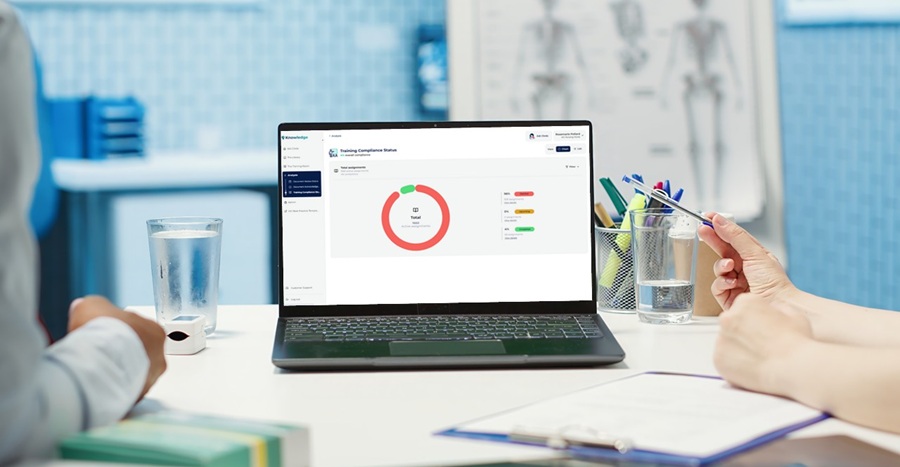
The most useful training compliance dashboards do this by pulling scattered training data into a single, current view rather than a static export that’s out of date the moment it’s generated. At minimum, a training compliance report should surface:
- Training status broken down by role, so gaps are visible against actual job requirements, not just headcount
- Overdue training, flagged clearly rather than buried in a spreadsheet column
- Upcoming expiry windows, so retraining can happen before a lapse rather than after
- Department and site breakdowns, so governance teams can see whether risk is isolated or systemic
- Knowledge-check results, showing where understanding is weak even when completion is strong
- High-risk gaps, prioritised by role criticality and regulatory relevance
- A board or governance-level summary, translating all of the above into the kind of narrative a board or regulator can actually use.
This is the reporting shape that HIQA and CQC inspectors are increasingly looking for: not a completion percentage, but evidence that an organisation understands and actively manages its own training risk.
How can Cloda turn training evidence into governance intelligence?
Cloda turns training evidence into governance intelligence by tracking mandatory training requirements and completion in one place, then surfacing the gaps and risks that matter to governance teams.
That evidence starts in The Training Room, which manages mandatory training requirements — tracking what training staff need to complete, when it’s due, and whether it’s been completed. Rather than compliance leads chasing certificates individually across departments and sites, The Training Room gives a clear, current view of training status across the whole organisation.
Through Compliance Insights, that training data doesn’t sit in isolation from the rest of the governance picture. Training status, overdue and expiring certifications, and role-level requirements are pulled together so that quality and governance teams can see, in one place:
- Which roles, departments or sites have the highest concentration of overdue or expiring training
- Where mandatory training requirements aren’t being met consistently across the organisation
- What needs to happen next — and who owns it
The result is a report that a director of nursing, compliance manager or board member can act on immediately, rather than a raw export that still needs to be interpreted before it means anything.
Conclusion
Completion data tells you that training happened. It doesn’t tell you whether your organisation is currently meeting its mandatory training requirements — that’s the job of training compliance analytics. By tracking staff through the full evidence chain, from assignment to expiry, and by giving that picture one clear home through Cloda’s Training Room and Compliance Insights, governance teams move from reactive box-ticking to genuine oversight of training risk. For HR leads, directors of nursing and quality managers preparing for HIQA or CQC scrutiny, that shift — from “who completed it” to “are we currently compliant, and where are we exposed” — is what turns a training record into governance intelligence.
Book a demo today to see Cloda’s Training Room in action. Contact info@cloda.ai or call 01 629 2559.
FAQs
Is training compliance analytics the same as an LMS? No. An LMS delivers and tracks course completion. Training compliance analytics interprets that data — alongside expiry, role relevance and knowledge-check results — to identify governance risk.
What training evidence do healthcare providers need? Healthcare providers need evidence that goes beyond a completion certificate: role-relevant assignment, valid completion, current (non-expired) status, and, where possible, an indicator of understanding such as a knowledge check.
How often should training compliance be reviewed? Training compliance should be reviewed on an ongoing basis rather than as a periodic exercise, with expiry windows, overdue training and knowledge gaps monitored continuously so issues are caught before an inspection or incident forces the question.

Book a Demo (1)
"*" indicates required fields