



Introduction
A policy acknowledgement proves a staff member opened a document. It doesn’t prove they understood it, or that they can apply it during care. For regulated healthcare providers, that gap isn’t a technicality — it’s a governance risk.
Inspectors, auditors, and families don’t ask “did staff sign the policy?” They ask “did staff know what to do?” Those are different questions with different answers.
Before we dive in, we would love to hear your thoughts below!
Poll: What’s the biggest obstacle to ensuring staff comply with policies and procedures in your organisation?
Cast your vote and see what your peers say!
What is policy acknowledgement?
Policy acknowledgement is a record confirming a staff member received, opened, or electronically signed off on a policy document.
It’s a distribution record, not a comprehension record. Most healthcare organisations rely on it because it’s easy to capture and easy to report: a timestamp, a name, a tick. It has genuine value as it proves a policy was issued and that a specific staff member has access to it. This is essential for basic compliance and for audit trails.
But acknowledgement answers one question only: did this person receive the policy? It says nothing about whether they read it properly, understood it, or could apply it under pressure on a busy shift.
Why is acknowledgement not the same as understanding?
Acknowledgement confirms staff members have access to a policy, not comprehension of it.
A staff member can click “I have read and understood this policy” without reading a single page. They can skim it during a rushed induction. They can understand the general topic but miss a specific procedural detail — the one that matters when an incident happens. None of that shows up in an acknowledgement log.
This is the governance risk: relying on read receipts creates a false sense of assurance. Cloda’s own data shows why. On average, staff spend just 3 seconds acknowledging a procedure. When a quiz is added, that time increases to 2.8 minutes — a clear sign of active engagement, not a passive click. That gap between 3 seconds and 2.8 minutes is the gap between acknowledgement and understanding, measured.
Boards and quality teams see 100% acknowledgement rates and assume the organisation is protected. Regulators are moving past that assumption. HIQA and CQC inspections increasingly probe how staff actually apply governance and safeguarding policies in practice — not just whether a signature exists on file. A clean acknowledgement report doesn’t hold up against a staff interview that reveals a knowledge gap.
What evidence can show staff understanding?
Healthcare organisations show real understanding through knowledge checks, quiz results, role-specific questions, and manager follow-up — not signatures alone.
Stronger evidence includes:
- Knowledge checks built directly into the policy sign-off process, not a separate afterthought.
- Quizzes that test specific, practical detail rather than general awareness.
- Refresher training, triggered automatically when a knowledge gap is identified.
- Manager follow-up, where a supervisor observes policies in practice.
- Repeat knowledge gap tracking, flagging when the role or department struggles with the same policy area more than once.
- Audit findings linked back to comprehension, connecting inspection outcomes to specific policy knowledge rather than treating them as isolated events
A quiz score is evidence of understanding, not proof of competence. It should sit alongside observation, incident review, and manager judgement — not replace them.
How do policy understanding gaps become compliance risks?
Unaddressed knowledge gaps don’t stay invisible, they surface later in incidents, complaints, audit findings, and inconsistent care delivery.
A staff member who acknowledged a medication management policy but never understood the escalation steps is a risk sitting quietly on file — until the day it isn’t. Inspectors reviewing governance and management arrangements (Regulation 23 in Ireland, Regulation 17 and the CQC Well-led framework in England) look for consistency between what’s documented and what actually happens on the floor. A gap between the two is exactly what draws a compliance finding.
The pattern is predictable: acknowledgement rate looks strong, an incident occurs, and the root cause review finds the relevant policy was “acknowledged” months earlier but never properly understood. That’s a preventable finding, not a surprise.
How can Cloda support policy understanding?
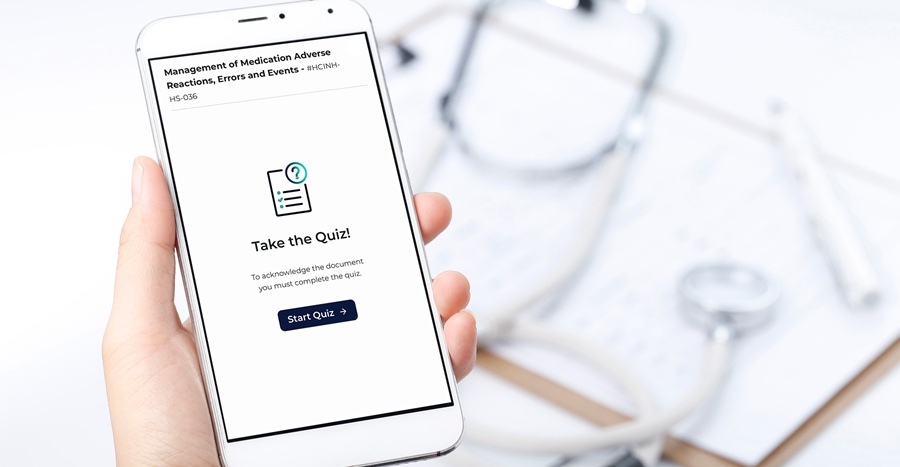
Cloda closes the gap between acknowledgement and understanding by adding a comprehension quiz before policy acknowledgement.
Rather than staff acknowledging a policy and moving on, they’re tested on it at the point of engagement, offering a seamless way to check comprehension immediately after reading. Unlike traditional training sessions that require time and logistics, embedded quizzes provide instant, scalable reinforcement, letting staff validate their understanding on the spot rather than simply confirming receipt. That’s what moves the process past passive acknowledgement and into active engagement.
Compliance Insights builds on that quiz data. It reports on the knowledge gaps themselves: which policies staff are asking questions about, and which policies staff are failing quizzes on. Instead of a single acknowledgement percentage, governance and training teams get a picture of where understanding is actually breaking down — by policy, by team, by individual.
Together, The Library with the built-in quiz function, and Compliance Insights give governance and training teams a single view: not just who has seen a policy, but who understands it, and where the next knowledge gap is likely to appear.
What should governance teams report?
Governance reports should show acknowledgement rates and comprehension evidence side by side.
Metric | What it shows |
Acknowledgement rate | Who has received and opened each policy |
Knowledge check completion rate | Who has actually engaged with a comprehension quiz |
Average score by policy | Where understanding is weakest across the organisation |
Departments or roles flagged for retraining | Who needs follow-up before the next audit cycle |
Repeat gaps by team or policy | Patterns suggesting a systemic issue, not an individual one |
Time from policy update to full staff comprehension | How quickly a change in practice actually reaches the floor |
A Board or Quality Committee that sees only acknowledgement rates is seeing half the picture. Add the comprehension layer and the report becomes something inspectors, and your own governance team, can trust.
Conclusion
Acknowledgement and understanding are not the same thing, and treating them as interchangeable leaves a gap that inspectors, incidents, and complaints will eventually find. A signature confirms a policy was received. It doesn’t confirm a staff member can act on it correctly, under pressure, on a real shift.
Closing that gap means moving past a single acknowledgement percentage. It means knowing who’s completed the quiz, who hasn’t, and where the actual knowledge gaps sit — by policy, by team, by individual. That’s the evidence governance teams need, and the evidence regulators are starting to ask for.
Cloda brings both layers together: The Library for the policy itself, analytics for who has engaged with it, and Compliance Insights for where understanding still needs work.
Book a demo
Close the gap between acknowledgement and understanding of procedures in your own organisation.
Book a Demo at info@cloda.ai or call 01 629 2559.
FAQs
Is a read receipt enough for policy compliance?
No. A read receipt confirms distribution, not understanding. Regulators and auditors increasingly look for evidence that staff can apply a policy, not just that they received it.
Can quizzes prove policy understanding?
Quizzes provide evidence of comprehension, not full proof of competence. They’re strongest when combined with manager follow-up, observation, and incident review — not used as a standalone measure.
How often should staff be tested on policies?
This depends on risk level and regulatory requirements, but high-risk policies (safeguarding, medication management, infection control) warrant more frequent checks than lower-risk administrative policies, plus a refresher whenever a policy is updated or a gap is identified.
What should a compliance report show?
It should show acknowledgement rates alongside comprehension evidence — knowledge check scores, flagged individuals, repeat gaps, and how quickly understanding spreads after a policy change — rather than acknowledgement figures alone.

Book a Demo (1)
"*" indicates required fields