



Introduction
Healthcare providers use audits to examine whether care, governance and operational processes meet agreed standards. However, an audit only creates value when its findings lead to clear, accountable and evidenced improvements.
The HSE National Centre for Clinical Audit describes an audit lifecycle that moves from selecting a topic and setting criteria through data collection, reporting, quality improvement and re-audit. This reinforces an important principle for healthcare organisations: completing an assessment is not the same as resolving the issues it identifies.
Healthcare audit management software supports this lifecycle by bringing audit schedules, assessments, evidence, findings, improvement actions and follow-up into one organised system. For buyers, the central question is not simply whether a platform can digitise an audit form. It is whether the system can help the organisation turn findings into visible, accountable and sustained improvement.
Before we dive in, we would love to hear your thoughts below!
Poll: When your last audit flagged a partially compliant or non-compliant finding, was it resolved before the next audit cycle?
Cast your vote and see what your peers say!
What is healthcare audit management software?
Healthcare audit management software manages audit planning, evidence, findings, improvement actions and closure in one traceable workflow.
Healthcare audit management software is a digital system used to schedule audits, complete assessments, retain supporting evidence and manage findings through to resolution. It may be used by hospitals, nursing homes, disability services, mental health services, home-support providers and other public, private or voluntary healthcare organisations.
It differs from financial audit software because it is designed around care quality, clinical governance, compliance and operational assurance. An effective platform creates a traceable connection between:
- The area or process examined
- The applicable standard, criterion or organisational requirement
- The evidence reviewed
- The finding recorded
- The resulting improvement action
- The evidence and review used to close that action
This connection is important because a completed audit score, on its own, provides limited assurance. Healthcare leaders also need to understand what was found, who was responsible for responding and whether the response was properly reviewed.
Why should buyers map their current audit process first?
Buyers should map their current audit process first so they can separate essential workflow needs from features that add cost or complexity.
Before comparing platforms, buyers should document how audits currently move through the organisation. This should include how audits are scheduled, who completes them, where evidence is retained, how findings are reported and how improvement actions are followed up.
Practical questions include:
- Are annual audit schedules maintained in spreadsheets or local calendars?
- Do different departments or services use different templates?
- Is evidence distributed across emails, paper files and shared drives?
- Are improvement actions tracked separately from the original audit?
- Can leaders quickly identify overdue audits and open actions?
- Can managers see whether the same finding is recurring across locations?
- Is there a consistent process for reviewing evidence before an action is closed?
Buyers should also establish whether the system must support a single service, several departments or a multi-location organisation. A platform that works for one local team may not provide the reporting, permissions or oversight required at regional or group level.
Which capabilities should a healthcare audit management system include?
The right system should support the full audit lifecycle, from scheduling and assessment to action tracking, review, closure and re-audit.
Healthcare audit management software should do more than convert paper checklists into online forms. It should support the connected stages that allow an organisation to plan its audit programme, complete assessments consistently and demonstrate how identified issues were addressed.
The table below outlines the practical difference between a fragmented audit process and a connected system.
| Audit Requirement | Common Fragmented Approach | What an Effective System Should Provide | Governance Value |
|---|---|---|---|
| Audit planning | Annual spreadsheet, emails or local calendars | A central schedule showing audits, owners, dates and status | Clear visibility of planned, due and overdue activity |
| Assessment | Different files or templates used by each service | Consistent assessments linked to the relevant audit topic and criteria | More reliable comparison and oversight |
| Evidence | Documents stored in inboxes, folders or paper files | Evidence retained with the relevant assessment or finding | A traceable record of how conclusions were reached |
| Findings | Free-text reports circulated after completion | Findings linked to supporting evidence and audit criteria | Greater clarity about the issue identified |
| Improvement actions | Follow-up managed through emails and reminders | Named owners, target dates, progress status and completion evidence | Clear accountability for the organisational response |
| Review and closure | Actions marked complete without documented review | Evidence-based review before final closure | Better assurance that an action was implemented appropriately |
| Re-audit | Follow-up dependent on local memory or manual reminders | Re-audit activity connected to the original finding and action | Visibility of whether improvement has been sustained |
| Reporting | Information manually compiled before meetings | Reporting on schedules, findings, overdue actions and recurring issues | More timely governance and management oversight |
Buyers should test whether the platform preserves the complete history of an audit. This includes changes to findings, assigned responsibilities, uploaded evidence, review decisions and closure. A status marked “complete” is not sufficient if the organisation cannot retrieve the information supporting that decision.
How should the software manage findings and quality improvement actions?
It should give every finding a named owner, target date, status, supporting evidence and documented review before final closure.
Audit findings can lose momentum when ownership is unclear or follow-up depends on individual emails. Every resulting action should have a clear description, accountable owner, realistic target date, current status and a defined expectation for completion evidence.
The system should also distinguish between an action being marked complete and its completion being reviewed. For example, uploading a revised document may show that work took place, but an appropriate reviewer may still need to confirm that the action addresses the original finding.
Governance teams should be able to identify:
- Actions approaching or passing their target dates
- Findings with no assigned owner
- Actions awaiting evidence or review
- Recurring findings across audits, departments or locations
- Closed actions that require later re-audit
- Areas where progress has stalled
Software can improve structure and visibility, but responsibility remains with the organisation. Managers and quality leaders must still decide whether an action is proportionate, whether the evidence is adequate and whether further work is required.
How can the system support HIQA readiness and governance evidence?
It can support HIQA readiness by making audit records, actions, evidence and approval histories easier to retrieve and review.
HIQA assesses relevant healthcare and social care services against the standards and requirements applicable to those services. Those requirements vary by service type, so healthcare audit management software cannot guarantee HIQA compliance or predict every document, record or explanation that may be requested.
A well-managed audit system can nevertheless make governance evidence easier to access. Instead of reconstructing an audit trail from spreadsheets, emails and shared folders, the organisation can retain the assessment, supporting evidence, findings, actions and closure records together.
Different stakeholders will require different levels of information. Senior leaders may need an overview of overdue activity, recurring findings and unresolved actions. Auditors, service managers and quality teams may need access to individual assessments, evidence and review decisions. Buyers should therefore assess reporting, permissions, audit history and information-retrieval capabilities rather than focusing only on the appearance of the audit form.
What should buyers assess for usability, implementation and GDPR?
Buyers should assess whether staff can use the platform easily while permissions, training, data protection and support fit the organisation.
A system will provide limited value if staff find it difficult or time-consuming to use. Buyers should test how easily a user can schedule an audit, complete an assessment, record a finding, assign an action, upload evidence and retrieve previous information.
The platform should fit the organisation’s governance arrangements, resources and level of digital maturity. A smaller provider may need a straightforward workflow with minimal administration, while a multi-location organisation may require central oversight combined with appropriate local access.
Implementation planning should cover:
- User roles and access permissions
- Administrator and manager responsibilities
- Staff training and ongoing support
- Migration of relevant templates or audit information
- Governance of changes to audit criteria
- Reporting responsibilities
- GDPR and organisational data-protection requirements
- How adoption and process consistency will be monitored
Technology should simplify the audit process rather than add unnecessary steps. Buyers should look for a system that gives quality teams sufficient control while remaining practical for the staff responsible for completing audits and improvement actions.
How should healthcare organisations compare shortlisted platforms?
Shortlisted platforms should be tested against a realistic organisational audit, not judged only through a generic sales demonstration.
A product demonstration should use an audit that reflects the organisation’s actual environment. This allows buyers to assess how the platform handles familiar criteria, evidence, findings, actions and reporting rather than relying on a simplified sales scenario.
The demonstration should show the complete workflow. Buyers should ask the provider to demonstrate how an audit is scheduled, completed and reviewed; how a finding becomes an assigned action; how completion evidence is recorded; and how leaders identify overdue or recurring issues.
Healthcare organisations should also ask:
- Can existing audit templates be represented appropriately?
- How are different services, locations and departments organised?
- Can permissions reflect existing governance responsibilities?
- What information is retained in the audit history?
- How are open and overdue actions reported?
- Can reviewers verify evidence before closure?
- How does the provider support implementation and staff training?
- What responsibilities remain with the customer?
- How will the system scale as audit activity grows?
A useful platform should make the organisation’s audit process more consistent and visible without forcing every service into an unnecessarily complicated workflow.
Where does Cloda’s Evaluation Station fit?
Cloda’s Evaluation Station connects audit scheduling, findings, assigned actions, progress tracking and completion evidence in one place.
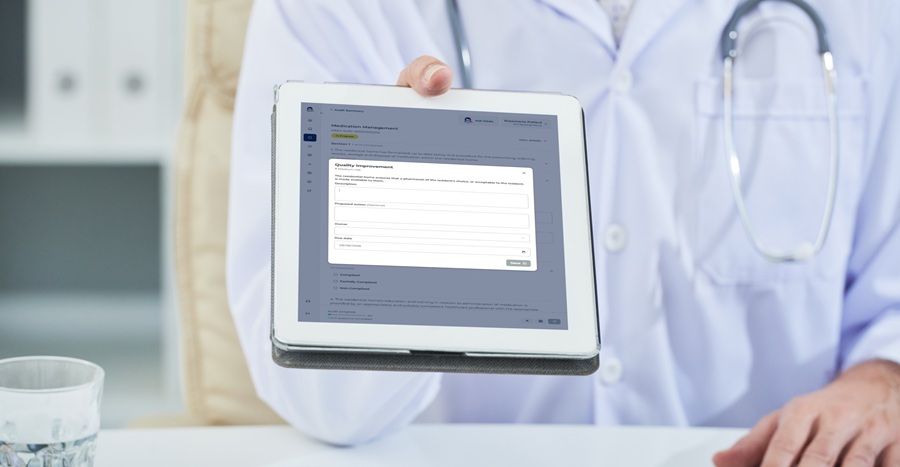
Cloda’s Evaluation Station is designed to support the internal healthcare audit lifecycle. Organisations can use it to schedule audits, record findings, assign improvement actions, monitor progress and retain evidence of completion within a connected workflow.
For providers currently dependent on separate spreadsheets, folders and email reminders, the Evaluation Station offers a more structured way to manage what happens after an audit. It creates continuity between identifying an issue, assigning responsibility, monitoring the response and documenting resolution.
As part of Cloda’s wider healthcare quality management environment, the Evaluation Station helps quality, governance and operational teams connect audit activity with accountable improvement. It supports organisational oversight while keeping the process practical for the staff carrying out the work.
Conclusion
Choosing healthcare audit management software should begin with a practical question: will the system help the organisation turn audit findings into visible, accountable and evidenced improvement?
Healthcare buyers should prioritise a complete audit workflow, reliable evidence retention, clear ownership, appropriate reporting and straightforward day-to-day use. Cloda’s Evaluation Station brings these elements together by supporting the internal audit lifecycle from scheduling and assessment through to action management, review and resolution.
If you would like a demo of Cloda contact us at info@cloda.ai or call 016292559.
Key Takeaways
- Healthcare audit management software should connect audit planning, evidence, findings, actions, review and closure.
- Buyers should map their current process before comparing features or providers.
- Every improvement action should have a clear owner, target date, status and completion evidence.
- Audit software can support HIQA readiness, but it cannot guarantee compliance or replace regulatory guidance.
- A realistic demonstration is essential for assessing usability, governance fit and implementation requirements.
FAQs
Is healthcare audit management software only for clinical audits?
No. It can support clinical audits as well as care quality, governance, compliance and operational audits. The organisation should configure its audit programme around the standards, criteria and assurance requirements relevant to each service.
Can healthcare audit software guarantee HIQA compliance?
No. Audit software can help organise evidence, findings and improvement actions, but it cannot guarantee regulatory compliance or anticipate every inspection requirement. Compliance remains dependent on the organisation’s practice, governance, professional judgement and response to applicable standards.
What is the difference between completing an audit and closing an audit action?
Completing an audit records the assessment and its findings. Closing an audit action should demonstrate that the agreed response was implemented, supported by evidence and reviewed by an appropriate person.
What should an organisation bring to a product demonstration?
The organisation should bring a realistic audit template, examples of typical findings and an outline of its approval process. This allows the provider to demonstrate how the system would work within the organisation’s actual audit and governance arrangements.
Disclaimer: This article was developed with the assistance of AI tools. All content has been verified using source documents. The content has been reviewed and edited by HCI to ensure accuracy and relevance to the specific context.

Book a Demo (1)
"*" indicates required fields