




Introduction
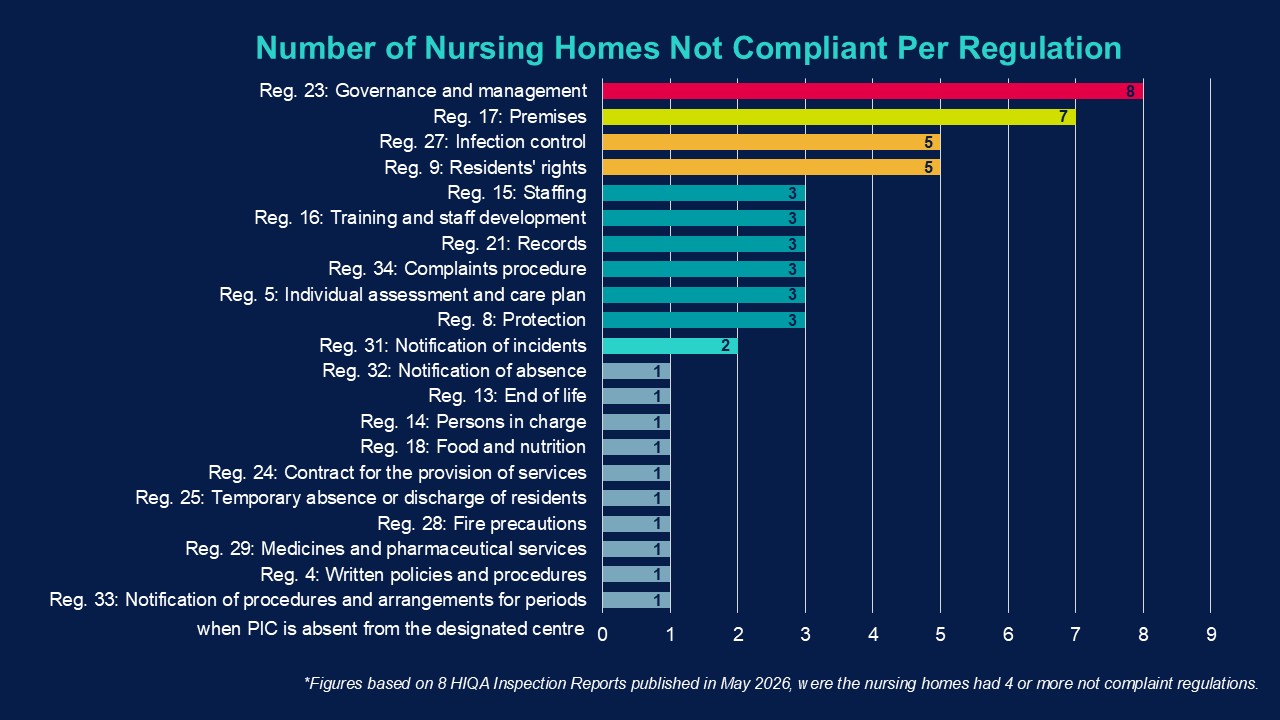
In May, HIQA published 50 inspection reports on nursing homes. Levels of non-compliance varied across the reports, with 17 centres non-compliant with three regulations or fewer, and eight centres non-compliant with four or more regulations.
This blog focuses on those eight centres with the higher levels of non-compliance and looks at the common themes emerging across the reports. While the findings varied between centres, several key areas appeared repeatedly: governance and management, staffing and supervision, residents’ rights, premises, infection prevention and control, safeguarding, records, complaints and care planning.
Across the reports, the most significant pattern was that non-compliance was often connected. Weak governance and oversight frequently had a knock-on effect across other areas of care, from staffing deployment and risk management to residents’ daily experience, privacy, dignity and choice.
The findings provide important learning for providers. They show that regulatory compliance depends not only on having best practice processes in place, but on whether those systems are working in practice, consistently monitored, and strong enough to identify and address risk before it impacts residents.
Before we dive in, we would love to hear your thoughts below!
Poll: What creates the most paperwork pressure in nursing home compliance?
Cast your vote and see what your peers say!
1. Governance and management: weak oversight was the central theme
Relevant regulation: Regulation 23 — Governance and management
The most consistent finding across the eight reports was weak governance and management. HIQA repeatedly identified that systems were not strong enough to ensure services were safe, appropriate, consistent and effectively monitored.
Key findings included:
- Insufficient oversight of staffing and resources: HIQA found that the provider had not ensured sufficient resources in line with the statement of purpose. Healthcare assistant, activity staff and chef whole-time-equivalent allocations were below the levels set out in the centre’s own statement of purpose.
- Audits not identifying real risks: Provider audits scored well in areas such as infection prevention and care planning, but did not identify issues inspectors found on the day. Risks were therefore not acted on or mitigated.
- Reactive rather than proactive governance: HIQA found that management systems were reactive and that further strengthening was needed in care planning, safeguarding, residents’ rights, premises and infection prevention and control. Audit tracking and trending were not identifying emerging themes.
- Unclear leadership and accountability: The Director of Nursing post was vacant, leaving a 39-hour weekly shortfall in nurse management hours. HIQA found that lines of responsibility and accountability were unclear, including for complaints and safeguarding.
- Failure to sustain improvements: HIQA noted that while some progress had been made, non-compliances persisted in care planning, protection, residents’ rights, premises and governance.
- Lack of leadership continuity: The person in charge was on statutory leave, no deputy had been appointed, a company director with senior oversight had resigned, and staff were unclear who was in charge. HIQA found significant failures in ensuring safe, consistent and effective care.
- Poor management of risk: HIQA found that management systems required strengthening in staff supervision, infection control, notifications, complaints, activities and risk management. For example, dishwasher detergent was stored on the floor of a residents’ communal toilet.
- Premises, infection control and policy implementation not adequately governed: Management systems were inconsistent and not effective. Inspectors found high-risk areas left open or unlocked, fire doors held open with chairs, policies not updated or implemented, infection-control oversight requiring strengthening, and a residents’ activity room being used by staff as a break room.
Overall theme: governance failures were not abstract management issues. They translated directly into risks for residents: missed safeguarding actions, poor care planning, delayed responses, unsafe premises, weak infection control and poor resident experience.
2. Staffing, deployment and supervision: numbers alone were not enough
Relevant regulations: Regulation 15 — Staffing; Regulation 16 — Training and staff development; Regulation 14 — Persons in charge
Several reports showed that staffing compliance was not just about whether staff were present. HIQA focused on whether staff were deployed effectively, supervised properly and supported to deliver safe, person-centred care.
Key findings included:
- Poor deployment in dementia care: HIQA found that staffing in the dementia-specific unit was not appropriately deployed during early morning hours. Residents at risk of falls were not adequately supervised. Staff were also not allocated to provide meaningful activities at weekends, and a qualified chef was not allocated at weekends.
- Ineffective deputising arrangements: The deputy for the person in charge was frequently required to cover night nursing duties, limiting their ability to oversee care and services.
- High turnover and delays in care: Residents reported that staff did not always know their needs and that they waited for assistance. Rosters showed reduced staffing on multiple days, including shortfalls of up to 48 hours in one day.
- Clinical managers filling roster gaps: Clinical nurse managers were rostered to compensate for staff nurse unavailability, reducing management oversight. HIQA also found reduced nursing cover at night and an inability to access agency staff to fill a healthcare vacancy.
- Training not translating into practice: HIQA found that supervision systems did not ensure call bells were answered in a timely way, safety pauses were implemented and recorded, or staff followed procedures for end-of-life care.
- Poor supervision of IPC and activities: Staff were observed using PPE incorrectly, not performing hand hygiene after care, and not providing adequate activities for residents when planned activities changed.
- Staff unclear about social-care roles: Staff were not clearly able to describe their role in providing meaningful activities, and inspectors found limited opportunities for meaningful social activity, particularly in one communal sitting room.
Overall theme: staffing non-compliance was closely linked to supervision, skill mix, deployment and contingency planning. Even where staff were caring and residents spoke positively about them, HIQA found that weak systems could leave residents waiting, unsupported or without meaningful daily activity.

3. Residents’ rights and quality of life: activity, choice, privacy and consultation
Relevant regulation: Regulation 9 — Residents’ rights
Residents’ rights findings were often about everyday quality of life: having something meaningful to do, being able to make choices, being consulted, and having privacy.
Key findings included:
- Limited meaningful activities: Activities were not scheduled at weekends and staff were not allocated to provide meaningful activities.
- Residents not supported to participate in activities: HIQA found that further action was needed to provide activities for residents who did not attend group events and to improve communication between residents and staff.
- Activities not matching residents’ interests and capacities: Residents’ social activity assessments did not adequately inform a programme of social activities. Many residents were not supported to participate in activities that interested them and matched their abilities.
- Lack of choice in communal spaces: One sitting room was overcrowded, seating arrangements did not support social interaction, some residents could not see the television, and residents in another room were not aware of activities happening elsewhere.
- Privacy and dignity in shared bedrooms: Wall-mounted privacy screens in two four-bedded rooms did not meet residents’ privacy needs, and residents lacked lockable storage.
- Restricted personal choice: Residents in twin bedrooms shared one television, meaning each resident could not independently choose what to watch or listen to.
- Residents not kept informed: Residents were unhappy that they had not been informed about works in the courtyard, including workmen appearing outside bedroom windows. Residents and visitors also expressed uncertainty about who was in charge.
Overall theme: residents’ rights are practical. They include privacy, personal choice, meaningful occupation, communication, consultation and control over daily life.
4. Premises and the lived environment: the building is part of care
Relevant regulation: Regulation 17 — Premises
HIQA’s premises findings showed how the physical environment affects dignity, safety, comfort and independence.
Key findings included:
- Unsuitable shared-room layouts: Two twin-occupancy bedrooms restricted residents’ ability to move safely, transfer, receive personal care in private, and maintain control over belongings.
- Four-bedded rooms not supporting privacy: Two four-bedded rooms continued to accommodate four residents, and privacy screens did not protect residents’ privacy needs.
- Inaccessible or unsuitable communal spaces: The conservatory was not accessible due to cold temperatures, and inappropriate items were stored in a visitors’ room.
- Residents’ space used for other purposes: A large activities room registered for residents’ use was being used by staff as a break room.
- Storage creating risks: An overcrowded storeroom made it difficult for staff to access equipment and also held clean clinical supplies, increasing cross-contamination risk.
- Poor repair and equipment failure: HIQA found damp in bedrooms, persistent malodours, a broken window, a broken oven, an out-of-order bedpan washer and a hoist with weighing capability not working.
- Fire-related environmental risks: HIQA identified a bolted bedroom window preventing an alternative means of escape, unsecured oxygen cylinders and an inaccurate evacuation list. An immediate action was issued.
Overall theme: premises findings were not cosmetic. They affected privacy, dignity, infection prevention, fire safety, independence and residents’ ability to use their home.
5. Infection prevention and control: cleaning, PPE, storage and outbreak management
Relevant regulation: Regulation 27 — Infection control
Infection prevention and control findings were found across several centres and often linked to wider governance and supervision failures.
Key findings included:
- Cleaning records not reliable: Cleaning tasks were recorded as completed before they had taken place, meaning oversight of cleaning practices was inadequate.
- Poor PPE and hand hygiene practice: Staff did not always wear PPE appropriately, changed PPE inconsistently and were observed wearing gloves inappropriately.
- Outbreaks not notified: Two recent outbreaks of infection had not been notified to HIQA as required.
- Unclean areas and pest concerns: Communal areas and quiet rooms were unclean, and live insects were observed in several areas, including a kitchenette.
- Dirty equipment and poor IPC infrastructure: HIQA found unclean kitchenette equipment, stained and worn tumblers, hand hygiene sinks needing deep cleaning, an out-of-order bedpan washer and uncertainty about who the IPC lead was.
- IPC requiring sustained improvement: Inspectors noted improvements in cleanliness and laundry arrangements but still found further action was required under infection prevention and control.
Overall theme: IPC compliance depended on systems as much as individual practice: reliable cleaning records, correct PPE, safe storage, clear leadership and timely outbreak notification.
6. Records, complaints and notifications: weak documentation undermined safety
Relevant regulations: Regulation 21 — Records; Regulation 34 — Complaints procedure; Regulation 31 — Notification of incidents; Regulations 32 and 33 — Notifications relating to absence of the person in charge
Several reports showed that poor records and weak complaint systems can hide risk and delay action.
Key findings included:
- Disjointed and incomplete records: Record-keeping was disjointed and difficult to review. The provider could not confirm training completion, and records relating to safeguarding and complaints were incomplete.
- Resident records not secure: Residents’ records were kept in an unlocked filing cabinet, with access possible for residents, visitors and persons not employed by the provider.
- Staff personnel files incomplete: Staff files were missing required Schedule 2 information, including vetting disclosures, employment history, references and other employment records.
- Complaints not recognised as complaints: Known dissatisfaction was recorded on a computerised system but not recognised and managed as complaints under the provider’s complaints policy.
- Complaints not documented: Staff confirmed verbal complaints had been received, but these were not recorded in the complaints log.
- No alternative complaints arrangements: The person in charge was the complaints officer, but no alternative arrangements were in place during their absence. Staff also did not have access to the complaints system.
- Safeguarding notifications missed: Possible safeguarding incidents, including missing money, were not recognised as potential safeguarding incidents and were not notified to HIQA.
- Failure to notify leadership absence: The provider did not notify HIQA that the person in charge had been absent for more than 42 days, and did not notify deputising arrangements or procedures for running the centre during that absence.
Overall theme: records, complaints and notifications are core safeguards. When they are weak, risk can become invisible.

7. Safeguarding and protection: recognising, reporting and acting on concerns
Relevant regulation: Regulation 8 — Protection
Safeguarding findings were particularly serious where concerns were not recognised, reported or managed through the correct process.
Key findings included:
- Possible abuse not recognised: Concerns raised by residents or families were recorded as complaints rather than managed through safeguarding processes.
- Safeguarding investigations incomplete or unavailable: Preliminary screenings and other relevant documents for open safeguarding investigations were not available to inspectors.
- Poor safeguarding plans: Safeguarding plans were described as basic and did not clearly set out the issues or actions required to safeguard residents.
- Staff working without Garda vetting: HIQA found people working in the centre without valid Garda vetting disclosures or required personnel documentation. This led to an immediate action plan.
- No safeguarding officer during leadership absence: In the absence of the person in charge, the provider had not nominated a designated safeguarding officer with responsibility for safeguarding oversight, reporting and compliance.
Overall theme: safeguarding depends on recognition, escalation, documentation, investigation and leadership. Training alone was not enough where systems did not ensure concerns were acted on.
8. Assessment, care planning and resident-specific care
Relevant regulation: Regulation 5 — Individual assessment and care plan
Care planning findings showed that residents’ assessed needs were not always translated into clear guidance for staff.
Key findings included:
- Care plans not sufficiently detailed: Inspectors found that care plans were not sufficiently detailed to guide staff in providing required interventions.
- Care plans not always person-centred or updated: HIQA found improvements but said further action was needed to ensure care plans were person-centred and updated to guide safe and effective care.
- Care documentation not reliably guiding staff: Care-plan audits did not identify that some care plans did not reliably guide staff on recommended care in line with residents’ assessed needs and preferences.
- Assessments and care plans missing for new admissions: Comprehensive assessments were not always completed for newly admitted residents and appropriate care plans were not developed.
- Care not informed by individual need: Inspectors found examples of generic care plans and institutional practices, including continence wear being used without clinical assessment.
Overall theme: care planning is not paperwork. It is the link between assessment and daily care.
Conclusion: turning inspection insight into practical improvement
Taken together, these eight inspection reports point to a clear message: the most serious areas of non-compliance were rarely isolated. They were usually part of a wider pattern involving governance, oversight, staffing, supervision, escalation and follow-through.
For providers, the lesson is straightforward. Compliance is not only about responding to an inspection report. It is about having systems that can identify concerns early, act on them quickly, and show clearly that risks are being managed before they affect residents’ safety, dignity and quality of life.
For the sector as a whole, Regulation 23 is often the regulation behind the regulation. When governance and management are weak, problems begin to surface elsewhere: in residents’ rights, staffing, premises, infection prevention and control, safeguarding, complaints, records, care planning and notifications.
Moving from inspection response mode to continuous readiness means making compliance visible in day-to-day practice. Tools like Cloda can help nursing homes turn inspection findings into trackable actions, support stronger audit follow-through, improve policy access for staff, and provide clearer evidence that improvements are embedded across the service.
By strengthening governance visibility, policy engagement and real-time assurance, providers can better demonstrate that they are not only addressing non-compliance after inspection, but actively preventing risks before they affect residents.
Introducing Cloda: A Smart Digital Assistant for Nursing Home Compliance
For nursing homes looking to strengthen HIQA compliance and support staff utilisation of the best practice policies you have invested in, Cloda is the compliance management system you need.
Cloda is the digital assistant available in staffs’ pocket to provide the answers they need to your policies and procedures — in their own language. In doing so, Cloda helps staff to deliver safer care, aligned with your best practice policies and procedures, and HIQA’s expectations. Because Cloda is mobile-friendly, staff can access her support instantly, when and where they need it.
Cloda helps translate HIQA regulations into day-to-day practice. As the regulatory landscape evolves with updates to standards, new thematic inspections, and revised national guidance, Cloda ensures staff are always working from the most current, organisation-approved policies and procedures. Her instant support allows staff to query information when required, helping confirm that their actions align with up-to-date regulatory expectations. With instant access to procedures, teams reduce variation in practice and improve consistency.
Built-in comprehension quizzes support managers to evidence that staff have read and understood key policies, while centralised training oversight helps streamline mandatory training requirements and highlight gaps before they become inspection findings. With real-time visibility of compliance, risk themes, and policy engagement, Cloda enables providers to move from retrospective inspection preparation to proactive governance — strengthening assurance under Regulation 23 and across the wider regulatory framework.
For more information or a demo of Cloda, contact info@cloda.ai or call 01 629 2559.

Book a Demo (1)
"*" indicates required fields