




Introduction
On the 27th August, HIQA published 50 inspection reports relating to designated centres for older people. Of these, 10 nursing homes were rated Not Compliant with four or more regulations.
A review of these 10 reports shows that the issues identified were rarely isolated. Governance weaknesses were frequently accompanied by concerns relating to incident reporting, residents’ rights, fire safety, care planning, infection prevention and control, staffing and other areas of care delivery.
Most notably, Regulation 23: Governance and Management was rated Not Compliant in all 10 of the centres reviewed.
Across the 10 reports, the regulations with the most Not Compliant ratings were:
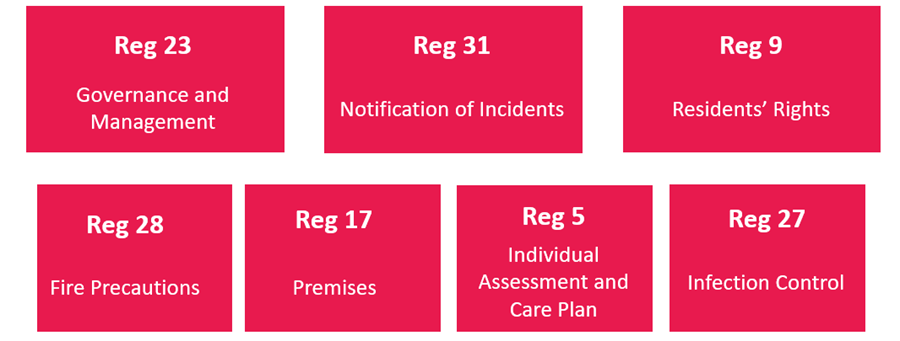
Regulation 23: Governance and Management
10 of 10 centres Not Compliant
Governance and management was the clearest issue emerging from the review. All 10 centres with four or more Not Compliant regulations were found to be Not Compliant with Regulation 23.
The findings suggest that the concern was often not the absence of governance systems, but whether those systems were sufficiently effective to identify risk, drive action and provide assurance that improvements had been implemented.
Theme 1: Audits were not consistently driving improvement
This theme appeared in several reports.
In one centre, inspectors found that meetings and audits did not consistently have documented action plans, while planned audits of care planning and documentation had not been completed. Another report found that a significant number of audits reviewed had no corrective action plan developed.
Elsewhere, infection-control audits had failed to identify issues subsequently identified during inspection, while another centre had insufficient oversight of clinical documentation and care-plan implementation.
Across the reports, this included:
- Audits without corrective action plans.
- Planned audits not being completed.
- Audit findings not being followed through.
- Internal monitoring failing to identify risks subsequently found by inspectors.
- Insufficient evidence that improvements had been sustained.
Theme 2: Weak oversight of known risks
Risk management was also a recurring governance issue.
- The risk register had not been updated since 2024 and did not include risks relating to staffing or complex admissions.
- Inadequate oversight of the centre’s risk register and identified an electrical and fire risk that had not been appropriately assessed.
- Systems had failed to recognise risks associated with insufficient resident supervision and night-time evacuation arrangements.
Theme 3: Incident and safeguarding oversight was not sufficiently robust
Several reports demonstrated weaknesses in the management of incidents and safeguarding concerns.
- Incident reports had not been reviewed since November 2025 and responsibility for reviewing and closing incidents was unclear.
- A potential safeguarding incident had not been appropriately documented or investigated.
- Ineffective oversight of safeguarding incidents, including failures to recognise and appropriately manage incidents in line with safeguarding procedures.
This suggests that governance systems need to provide visibility not only of incident numbers, but also of investigation, escalation, learning and close-out.
Theme 4: Accountability and management arrangements were unclear
Inspectors identified weaknesses in management structures in a number of centres.
- Accountability for risk, incidents and complaints was unclear.
- The newly established management structure had not yet provided sufficient oversight of staff supervision, documentation, cleaning and maintenance.
- Changes in senior management had not been appropriately notified, alongside weaknesses in governance arrangements during the prolonged absence of the person in charge.
Theme 5: Previous actions and known issues remained outstanding
Repeat or unresolved findings appeared in several reports.
- Fire and premises works were no completed in accordance with its agreed phased plan.
- Outstanding commitments relating to maintenance, storage and private visiting facilities from an earlier inspection.
- Recommendations from previous evacuation drills had not been actioned, while premises issues identified in earlier compliance plans also remained unresolved.
Regulation 31: Notification of Incidents
6 of 10 centres Not Compliant
Notification failures appeared across six of the 10 reports.
Theme 1: Significant incidents were not notified
The types of incidents not notified varied across centres.
- Inspectors identified a potential safeguarding incident, an outbreak of a notifiable disease, an unexpected death and an injury requiring hospital admission that had not been appropriately notified.
- A centre failed to notify numerous safeguarding allegations and an outbreak of a notifiable disease.
- Both an unexpected death and an allegation of abuse that had not been submitted through the required notification process.
Theme 2: Notification timeframes were not met
Timing was another recurring issue.
- A fall resulting in hospital admission had not been reported within the required timeframe.
- A safeguarding allegation that had not been notified within two working days.
- An outbreak of a notifiable disease had not been reported within the prescribed timeframe.
Theme 3: Reporting systems were incomplete or inaccurate
The issue was not limited to individual incident notifications.
- A centre had not submitted its required quarterly report covering matters including restraint and a resident death.
- The quarterly return did not accurately record pressure ulcers present on residents’ admission.

Regulation 9: Residents’ Rights
6 of 10 centres Not Compliant
Residents’ rights findings demonstrate how staffing, premises, care planning and operational decisions can directly influence residents’ day-to-day experience.
Theme 1: Choice and autonomy were not always supported
- Six of 11 residents requiring assistance were still waiting to begin their day shortly before lunch despite documented preferences within their care plans.
- A resident who wished to smoke was to be informed that there was no smoking area available, despite their preferences being documented in their care plan.
- Shower schedules organised by room number rather than individual choice.
- Residents’ ability to independently access and return from an outdoor garden was restricted by a coded locking system.
Theme 2: Meaningful activities were limited
Several reports identified deficits in activity provision.
- Residents who remained in their bedrooms had inadequate access to meaningful activities, including residents receiving bed rest who had no meaningful engagement for several days.
- Inconsistent activity provision across different units and relied on care staff to provide activities, meaning alternatives were not always available.
- Activity resources were limited across four units and activity staff were sometimes diverted to personal care duties.
Theme 3: Privacy and dignity were compromised
Privacy concerns were identified in more than one report.
- Bedroom vision panels and privacy curtains did not provide adequate privacy and dignity.
- Privacy issues in shared bedrooms, where environmental limitations meant residents could not move around their own bed space without affecting the rights of their roommate.
- Shared bathrooms did not have locks and concerns were identified regarding residents’ personal furniture and possessions.
Theme 4: Resident consultation was not always resulting in action
- Issues raised at resident meetings did not have documented action plans and requests for additional activities remained outstanding.
- Residents and their representatives were not always appropriately consulted about how the centre operated.
Regulation 28: Fire Precautions
5 of 10 centres Not Compliant
Fire safety concerns were identified across several different aspects of fire management.
Theme 1: Fire containment was inadequate
- Deficient fire doors, gaps around doors, missing seals and issues with service penetrations through fire-rated walls and ceilings.
- Fire-containment and compartmentation works remained incomplete, including outstanding works to fire doors.
- Risk rooms that did not have appropriate fire doors, together with door-maintenance and compartmentation issues.
Theme 2: Fire risks were created by inappropriate storage and equipment
Inspectors identified combustible and flammable materials in inappropriate locations in several centres.
- Fuel cans and detergents stored close to a generator, unsecured oxygen cylinders and combustible storage on a staircase.
- Flammable materials, cardboard, furniture and electrical equipment stored within an electrical plant room.
- Equipment was being charged on a protected escape corridor and large quantities of highly flammable hand gel were stored in a room that was not appropriately fire rated.
Theme 3: Evacuation arrangements did not always reflect real conditions
This was particularly evident in relation to staffing.
- Previous drill recommendations concerning supervision of residents outside the evacuated compartment had not been actioned.
- Inspectors could not be assured that night staffing would be sufficient to safely evacuate a resident assessed as requiring three staff.
- Fire drills did not adequately reflect the risks or evacuation strategy of the centre.
This reinforces the need to test evacuation plans against actual dependency levels, staffing levels and building layout, rather than viewing completion of a fire drill as sufficient assurance.
Regulation 17: Premises
4 of 10 centres Not Compliant
Theme 1: Maintenance issues were not being addressed promptly
Several centres had recurring maintenance deficits.
- Damaged flooring, worn doors and window sills, storage problems and faulty refrigeration equipment.
- A broken shower, rusted grab rails, mould and a leak within an escape stairway.
- Incomplete flooring repairs, bedroom refurbishment and furniture replacement.
Theme 2: The environment affected privacy and independence
- 10 twin bedrooms did not provide sufficient space for residents and could make it difficult to use equipment or move around without disturbing another resident.
- Missing call bells in toilets, visiting areas and other spaces, reducing residents’ ability to independently summon assistance.
Theme 3: Storage arrangements were inappropriate
- A centre used vacant bedrooms to store resident equipment and electrical distribution rooms for storage.
- Residents’ care equipment and personal belongings stored within a records room.
Regulation 5: Individual Assessment and Care Plan
3 of 10 centres Not Compliant
Theme 1: Care plans did not consistently reflect current needs
- Wound-care plans were not updated following skin tears, lacerations or blisters, while falls care plans were not updated following incidents.
- Care plans were not always developed from comprehensive assessments and that required interventions were missing.
Theme 2: Care documentation contained conflicting or insufficient information
- Inspectors found conflicting information about hoist requirements and nutritional-risk scores.
- A care plan did not specify the number of staff required to support a resident, while a skin-care intervention had not been appropriately incorporated into a care plan.
- A diabetes care plan that did not contain appropriate blood-glucose parameters or clear actions for staff.
Theme 3: Care plans were not always translating into care
This was particularly significant.
- Important safeguarding and visiting interventions contained within care plans were not known to frontline staff because they were not communicated through the handover process.
- Gaps in repositioning and wound-care interventions, while falls-management actions were not consistently followed.
Regulation 27: Infection Control
3 of 10 centres Not Compliant
Theme 1: Infection risks were not always identified early enough
- Failure to recognise the early stage of an outbreak contributed to infection spreading from two residents to 11 residents and five staff.
- Infection-control audits had not identified several risks later identified by inspectors.
Theme 2: Cleaning and decontamination practices created risk
- Reused urinals that were not appropriately cleaned, creating an infection risk for residents with urinary catheters.
- Housekeeping shortages meant deep cleaning of bedrooms had not been completed.
- Cleaning staff were not promptly informed of the need for enhanced cleaning during an outbreak and appropriate disinfectant was not immediately available.
Theme 3: Cross-contamination risks were evident
- Blood-glucose monitoring equipment intended for individual use being shared between residents, alongside inappropriate hand-gel management.
- Staff travelling to or from work in uniforms and personal belongings being stored on care equipment in a communal bathroom.
- A member of staff providing care without the required PPE during an infection outbreak.
Other Areas of Non-Compliance
Some regulations were rated Not Compliant in only one of the 10 reports. These should still be highlighted, but we cannot genuinely demonstrate a recurring cross-report theme within this particular sample.
They included:
- Regulation 15: Staffing — insufficient staffing or skill mix to meet residents’ assessed needs, delays in supporting residents to get out of bed, inadequate supervision in communal areas and reduced access to meaningful activities.
- Regulation 16: Training and Staff Development — staff training did not always translate into practice, with issues identified in safeguarding, infection prevention and control, medication management, care documentation and residents’ rights. Weak staff supervision was also identified.
- Regulation 18: Food and Nutrition — concerns included food quality and temperature, limited fresh food options and insufficient staffing to provide timely mealtime support.
- Regulation 8: Protection — safeguarding incidents were not always recognised or appropriately managed and supervision arrangements did not adequately control identified risks.
- Regulation 21: Records — confidential records were stored in an unlocked location accessible to staff.
- Regulation 26: Risk Management — deficiencies were identified in the centre’s risk-management policy, including incident investigation, learning and major-incident preparedness.
- Regulation 29: Medicines and Pharmaceutical Services — medication administration records were signed before medicines had actually been administered.
- Regulation 32: Notification of Absence — the Chief Inspector had not been notified of a prolonged absence of the person in charge.
- Regulation 34: Complaints Procedure — weaknesses were identified in the recording, investigation and management of complaints.
- Registration Regulation 6 — a change in a person participating in management had not been notified within the required timeframe.
What do these findings tell nursing home providers?
Looking across the 10 reports rather than at individual centres makes several recurring patterns much clearer.
Governance was the connecting issue. All 10 centres were Not Compliant with Regulation 23, and many of the findings under other regulations could also be traced back to weaknesses in oversight, escalation or follow-through.
Audits alone do not provide assurance. Several reports identified audits that did not have action plans, did not identify the risks later found by inspectors, or did not demonstrate that corrective actions had been completed.
Training completion does not necessarily mean practice is compliant. Inspectors identified instances where staff had completed training but expected practice was not consistently being implemented.
Care plans need to translate into care. Outdated plans, conflicting information and poor communication meant that documented interventions were not always understood or followed by frontline staff.
Staffing has consequences beyond Regulation 15. Staffing pressures were also reflected in findings relating to residents’ rights, nutrition, activities, supervision and fire evacuation.
Repeat findings remain an important warning sign. A number of reports identified issues that had previously been raised or actions that remained incomplete.
For providers, the question is therefore not simply whether the required systems exist.
It is whether the organisation can demonstrate that those systems are identifying risk, prompting action, changing practice and sustaining improvement.
The fact that all 10 of the centres with four or more Not Compliant regulations were also Not Compliant with Regulation 23 makes governance and oversight the clearest theme emerging from this review.
How Cloda Supports Compliance
For nursing homes looking to strengthen HIQA compliance and support staff to use the best practice policies and procedures their organisation has invested in, Cloda helps connect governance requirements with day-to-day practice.
Cloda is a digital assistant available in staff members’ pockets, providing instant answers from organisation-approved policies and procedures — in their own language. Cloda also comes pre-loaded with 70+ best practice policy and procedure templates, kept current by HCI’s Best Practice Team, helping nursing homes maintain access to up-to-date guidance as requirements evolve.
As HIQA reviews the National Standards for Residential Care Settings for Older People in Ireland, nursing homes will need to adapt to changing expectations. Cloda can support this by helping ensure updated policies and procedures are quickly accessible to staff and translated into frontline practice.
Built-in comprehension quizzes, training oversight and real-time visibility of policy engagement help providers identify knowledge gaps, strengthen assurance and support proactive governance under Regulation 23 and across the wider regulatory framework.
For more information or a demo of Cloda, contact info@cloda.ai or call 01 629 2559.
Disclaimer: This article was developed with the assistance of AI tools. All content has been verified using source documents. The content has been reviewed and edited by HCI to ensure accuracy and relevance to the specific context.

Book a Demo (1)
"*" indicates required fields

As Chief Research Officer, Oonagh is responsible for the development of Quality and Safety Management Systems that effectively address organisational regulatory requirements while meeting business needs. Through her evaluation of emerging research, tools and technologies, Oonagh ensures that best-in-market techniques are utilised throughout HCI services. A qualified ISO Lead Auditor and experienced lecturer at NUIG, she has been central to HCI’s work with regulatory bodies in developing standards for key care sectors.