



Introduction
AI is changing healthcare policy management by turning static policy libraries into live governance systems. Instead of only storing documents, healthcare organisations can use AI to surface approved guidance, monitor version control, test staff understanding, support audit evidence, identify policy-related risks and trigger review cycles. The priority is not automation for its own sake; it is safer, faster and more accountable policy management across clinical, operational and regulatory workflows.
Cast your vote to see what your peers say!
Poll: What’s Your Greatest Policy and Procedure Challenge?
Take a moment to reflect on your organisation’s approach to policies and procedures. Which of these challenges resonates most with your experience?
Why is AI changing healthcare policy management?
AI shifts healthcare policy management from document storage to evidence-led governance, where access, understanding and risk are measurable.
For many healthcare organisations, policy management has traditionally meant writing documents, storing them centrally, asking staff to acknowledge them and retrieving evidence when an audit, inspection or incident occurs. That model is under pressure. Regulations change quickly, care is delivered across more settings, staff turnover remains high, and policy evidence is increasingly expected to be available in real time.
AI changes the operating model because it can help teams connect policy content with staff behaviour, training activity, audit findings, incident themes and risk signals. In practical terms, this means healthcare policy management becomes less about “where is the policy?” and more about “is the right policy current, accessible, understood and evidenced?”
The global direction supports this shift. The WHO’s report on regulatory considerations for AI in health highlights risk-benefit assessment, evaluation and ongoing performance monitoring as central considerations for safe AI adoption. In Europe, the EU AI Act uses a 4-tier risk approach, while the European Health Data Space creates a staged framework for electronic health data exchange, secondary use and interoperability. These developments reinforce a simple message for providers: AI must be governed as part of a wider quality, safety and compliance system.
How can AI improve access to approved policies at the point of care?
AI helps staff retrieve approved policies faster, but it must show source, owner, version date and limits to avoid unsafe guidance.
Frontline teams do not have time to search through folders, intranet pages or long PDFs during a busy shift. Nurses, carers, allied health professionals and managers need fast access to current procedures for medicines, safeguarding, infection prevention, incident escalation, complaints, resident care and clinical governance.
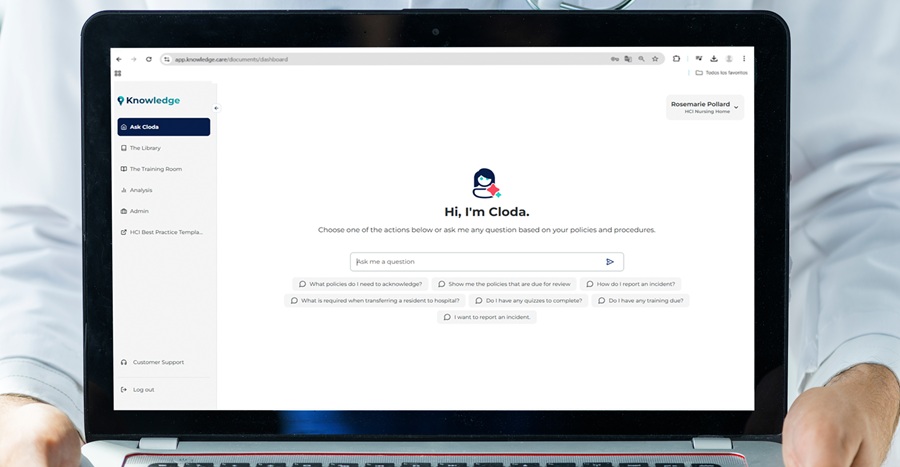
AI-enabled policy search such as Cloda can help staff ask natural-language questions and retrieve relevant guidance from an approved policy library. This is especially valuable for multi-site providers, home care teams, community services, hospitals and aged care organisations where staff need mobile access and consistent answers across locations.
The limitation is important: AI should not invent policy, replace clinical judgement or draw from uncontrolled sources. A safe healthcare policy management software should return approved content, show where the answer came from, display the current version and make clear when staff need to escalate to a manager, clinician or governance lead.
How does AI move compliance from acknowledgement to understanding?
AI can turn policy engagement, acknowledgements and quizzes into early signals of staff knowledge gaps and retraining needs.
Policy acknowledgement is a weak signal on its own. A staff member may confirm that they have read a policy, but that does not prove they understood it, remembered it or can apply it during care delivery. Cloda’s data shows that, on average, staff spend just 3 seconds acknowledging a document, suggesting that acknowledgement alone may not provide meaningful assurance of understanding.
AI can strengthen healthcare compliance by connecting policy updates with microlearning, short quizzes, comprehension checks, targeted retraining and knowledge-gap reporting. This matters because many compliance failures are not caused by the absence of a policy. They happen because the policy is difficult to find, difficult to understand, inconsistently applied or not embedded into daily practice.
Cloda’s data shows that when a quiz is added to a policy, staff spend an average of 2.8 minutes on the policy before acknowledgement, compared with just 3 seconds without a quiz. This indicates a shift from passive acknowledgement to more active engagement with the content.
For directors of nursing, registered managers, quality leads and compliance managers, this creates a more useful governance question: “Which teams may need support before a gap becomes a safety or inspection issue?” Signals may include low engagement with critical policy updates, repeated quiz errors, delayed acknowledgements, recurring searches for the same topic or incident themes linked to misunderstood procedures.

How does AI support audit readiness and inspection evidence?
AI strengthens audit readiness by linking policies, approvals, staff evidence, actions and risks before an inspector requests proof.
Healthcare policy management software should not sit apart from incidents, complaints, safeguarding concerns, audit findings or risk registers. These workflows are connected. A recurring incident may show that a policy is unclear. A complaint may reveal that staff guidance is not consistently followed. A risk review may show that controls exist on paper but are not understood in practice.
AI can help governance teams detect patterns across these signals. It may identify repeated incident themes, link complaints to relevant procedures, prompt policy review after serious events, support lessons-learned summaries or highlight risks that need escalation.
This is where policy management becomes part of continuous quality improvement. Instead of reviewing policies only on a fixed cycle, leaders can review them when evidence suggests that practice is changing, risk is rising or staff are struggling to apply guidance.
For a multi-site provider, this visibility matters. A single policy issue may look minor in one location but significant when seen across multiple services. AI can support that wider view, provided the organisation has strong data governance and clear human accountability.
| Governance requirement | Legacy policy management | AI-enabled policy management |
|---|---|---|
| Policy access | Staff search folders, binders or intranets | Staff ask questions and retrieve approved guidance quickly |
| Version control | Manual naming and document review logs | Current version, owner, approval date and review status are surfaced |
| Staff acknowledgement | One-off sign-off or email confirmation | Engagement, acknowledgement and understanding can be tracked together |
| Training evidence | Separate LMS or spreadsheets | Policy updates can trigger learning, quizzes and retraining signals |
| Audit readiness | Evidence gathered manually before inspection | Live evidence trail supports faster preparation |
| Leadership reporting | Static monthly or quarterly reports | Real-time compliance insights and trend visibility |
The nuance is that AI does not remove the need for disciplined governance. It increases the value of clean metadata, clear ownership, approved content and structured evidence. Poorly controlled documents become more dangerous when AI can retrieve them quickly.
How does AI connect policies with incidents, complaints and risk?
AI can connect incidents, complaints and risks to policy review, helping leaders spot weak controls before harm repeats.
Healthcare policy management should not sit apart from incidents, complaints, safeguarding concerns, audit findings or risk registers. These workflows are connected. A recurring incident may show that a policy is unclear. A complaint may reveal that staff guidance is not consistently followed. A risk review may show that controls exist on paper but are not understood in practice.
AI can help governance teams detect patterns across these signals. It may identify repeated incident themes, link complaints to relevant procedures, prompt policy review after serious events, support lessons-learned summaries or highlight risks that need escalation.
This is where policy management becomes part of continuous quality improvement. Instead of reviewing policies only on a fixed cycle, leaders can review them when evidence suggests that practice is changing, risk is rising or staff are struggling to apply guidance.
For a multi-site provider, this visibility matters. A single policy issue may look minor in one location but significant when seen across multiple services. AI can support that wider view, provided the organisation has strong data governance and clear human accountability.
What do UK, Irish and Australian healthcare organisations need to consider?
UK, Irish and Australian providers need AI governance that respects local standards while improving evidence, access and accountability.
Cloda’s core geographies — the UK, Ireland and Australia — all share a common challenge: healthcare providers must show that policies are current, accessible, understood and evidenced. The regulatory language differs by market, but the operational problem is similar.
In the UK, healthcare and social care providers need policy evidence that supports safe care, inspection readiness, clinical governance and staff competency. In Ireland, providers face continued pressure around governance, risk management, safeguarding, home support regulation, nursing home compliance and HIQA inspection evidence. In Australia, the National Safety and Quality Health Service Standards include 8 standards, while the national healthcare interoperability plan identifies 44 actions across 5 priority areas, including identity, standards, information sharing, innovation and measuring benefits.
AI should therefore be implemented with localisation in mind. A policy management tool must reflect the organisation’s regulatory environment, service type, staff roles, language needs, access controls and evidence requirements. A hospital CIO will care about integration, cybersecurity and interoperability. A Director of Nursing will care about point-of-care usability and staff adoption. A registered provider or care home manager will care about simplicity, cost, inspection readiness and evidence that staff are following current procedures.
The practical lesson is clear: global AI principles matter, but local governance workflows decide whether the system works.
What should healthcare leaders look for in AI policy management software?
Healthcare leaders should assess AI policy tools on safety, explainability, integration, evidence quality and frontline adoption.
Healthcare leaders should avoid treating AI as a feature checklist. The better test is whether the system strengthens governance, reduces avoidable admin and helps staff make safer use of approved information.
Before selecting AI-enabled healthcare policy management software, leaders should assess:
| Assessment area | What to ask |
|---|---|
| Approved source control | Does the AI retrieve only approved policies, procedures and guidance? |
| Source transparency | Does every answer link back to the source document, owner, version and review date? |
| Staff usability | Can frontline staff access guidance quickly on mobile or shared devices? |
| Multilingual support | Can diverse workforces understand key procedures without informal translation workarounds? |
| Evidence trail | Can leaders evidence policy updates, acknowledgements, understanding and retraining? |
| Audit readiness | Can the system surface missing evidence before inspection or accreditation review? |
| Integration | Can it work alongside HR, LMS, EHR, QMS or document systems without creating another silo? |
| Security and privacy | Are access controls, audit logs and data governance appropriate for healthcare? |
| Human oversight | Are high-risk outputs reviewed, governed and escalated appropriately? |
| Reporting | Can governance teams see trends by policy, role, department, site or service? |
The right system should support clinical and operational teams without adding complexity. If a tool increases helpdesk tickets, requires excessive training or creates another disconnected platform, adoption will suffer.

What are the limits of AI in healthcare policy management?
AI cannot replace clinical judgement, policy ownership or governance accountability; it should support controlled administrative workflows.
AI has limits, especially in healthcare. It can retrieve, summarise, classify, prompt and analyse. It should not become the final authority on care, regulatory interpretation or professional judgement.
Cloda can help healthcare organisations make approved policies easier to find, understand and evidence. It does not replace clinical judgement, legal advice, regulatory inspection, professional accountability or local policy ownership.
The strongest AI implementations will include clear human review, role-based permissions, approved knowledge sources, audit logs, data-protection controls and defined escalation routes. Staff should know when to rely on the system, when to check the underlying policy and when to escalate to a manager or clinician.
This limitation builds trust. In healthcare, safe AI adoption depends on being clear about what the technology can and cannot do.
What does this mean for the future of healthcare policy management?
The future of healthcare policy management is live, evidence-rich and human-led, with AI supporting safer governance decisions.
Healthcare policy management is becoming a real-time governance discipline. The future is not a larger document library. It is a connected system that helps leaders understand whether policy is current, accessible, understood, evidenced and improving practice.
The global signals are consistent. The EU AI Act places high-risk systems under stricter requirements. The European Health Data Space sets staged milestones for digital health data use, including major application dates in 2029 and 2031. The UK MHRA Software and AI as a Medical Device Change Programme includes 11 work packages across 2 workstreams, with 3 focused on AI-specific issues such as rigour, interpretability and adaptivity. Australia’s interoperability plan sets out 44 actions across 5 priority areas.
For healthcare leaders, these numbers point to one conclusion: AI will not reduce the need for governance. It will raise the standard of governance expected around digital systems, policy evidence and staff accountability.
The organisations that benefit most will not be those that adopt AI fastest. They will be those that use AI to make approved knowledge easier to access, staff understanding easier to evidence and risk easier to see before it becomes a failure.
Conclusion
AI is not replacing healthcare policy management; it is raising the standard for how policies are accessed, understood, evidenced and improved. For healthcare organisations, the opportunity is to move beyond static document control and build a more responsive governance system where approved guidance is available at the point of care, staff understanding can be measured, and emerging risks can be seen earlier.
The most effective use of AI will be human-led, source-controlled and evidence-rich. Leaders still need clear ownership, clinical judgement, local accountability and strong data governance. But with the right safeguards in place, AI-enabled policy management can help providers strengthen compliance, improve audit readiness and support safer, more consistent care across services.
For healthcare organisations in the UK, Ireland, Australia and beyond, the direction is clear: policy management is becoming a live governance function. The organisations that gain the most will be those that use AI not just to find policies faster, but to make approved knowledge easier to apply, staff understanding easier to evidence, and quality improvement easier to sustain.
If you would like information on how Cloda can support your healthcare organization with AI powered access to policies and procedures, contact info@cloda.ai or book a demo today.
Key Takeaways
- AI is changing healthcare policy management from static document control into live governance intelligence.
- The strongest use cases are policy access, version control, staff understanding, audit evidence, incident learning and risk visibility.
- UK, Irish and Australian providers should align AI policy tools with local regulatory expectations, inspection models and evidence requirements.
- AI should retrieve from approved policy sources, show version and ownership data, and support human-led governance.
- AI should be positioned as an administrative and compliance support tool, not a replacement for clinical judgement or regulatory accountability.
Frequently Asked Questions
How is AI used in healthcare policy management?
AI is used to help staff find approved policies faster, summarise updates, monitor acknowledgements, test understanding and identify compliance gaps. It can also support audit readiness by connecting policies, training records, evidence and governance reports.
Can AI replace manual policy review in healthcare?
No. AI can flag overdue reviews, summarise changes and support evidence gathering, but policy ownership must remain with accountable healthcare leaders. Human review is essential where policies affect clinical care, regulatory compliance or staff responsibilities.
Why is AI useful for audit and inspection readiness?
AI can help teams identify missing evidence before an inspection, including overdue policy reviews, incomplete acknowledgements and weak training records. This helps organisations move from reactive evidence gathering to continuous inspection readiness.
What risks should healthcare leaders consider before using AI for policy management?
The main risks are inaccurate outputs, poor source control, weak data governance, over-reliance by staff and unclear accountability. A safe AI policy management system should use approved content, show sources, maintain audit logs and include human oversight.

Book a Demo (1)
"*" indicates required fields