



Introduction
The traditional policy management software for healthcare gives every staff member instant access to the most current version of a policy, tracks who has read and understood it, flags documents due for review, and produces an audit trail regulators can check in seconds.
Increasingly, the strongest systems go further than static document storage, using AI to let staff ask a policy question in plain language and get an instant, accurate answer, and to verify genuine comprehension rather than just a tick-box acknowledgement. Cloda is built around this fuller standard: an AI-enhanced quality management system, not just a policy repository.
Cast your vote to see what your peers say!
Poll: What’s Your Greatest Policy and Procedure Challenge?
Take a moment to reflect on your organisation’s approach to policies and procedures. Which of these challenges resonates most with your experience?
Why Do Policies and Procedures Matter in Healthcare?
Policies and procedures matter in healthcare because they are the operational backbone of safe, consistent, high-quality care.
The Mental Health Commission defines a policy as a written statement that clearly indicates the position of the organisation on a given subject and a procedure as a written set of instructions that describe the approved and recommended steps for a particular act or sequence of acts. Together, they tell staff what to do, why, and to what standard, and they give inspectors and auditors a documented basis to assess whether that standard is actually being met.
Done well, policies and procedures deliver:
- Consistency – continual adherence to an agreed, evidence-based process
- Clarity – a clear description of how things are done in this organisation, not generically
- Education and training – a reference point that helps new and existing staff understand their responsibilities
- Continuous improvement – the review cycle forces teams to stop and reassess how they work
- Teamwork – input from multiple roles produces more practical, usable documents
- Assessment – a defined framework to measure practice against
- Improved care – standardised service delivery across shifts, teams and sites
- Accountability – demonstrable compliance with regulatory and legislative requirements
The problem most providers run into isn’t writing good policies, it’s keeping them alive. A policy that’s accurate on the day it’s approved but three years out of date, buried in a shared drive, or unread by half the staff it applies to isn’t protecting anyone. That gap between having policies and having a genuinely current, accessible and auditable policy management system is exactly where software becomes essential.
What Is Healthcare Policy Management Software?
Healthcare policy management software is a digital system that centralises an organisation’s policies, procedures and guidelines (PPGs), enables version control, distributes them to the right staff, records staff acknowledgement, and generates evidence for audits and inspections.
Instead of managing documents through email chains, shared drives, or printed binders, staff and managers work from a single source of truth.
At its core, a genuine policy and procedure management system for healthcare should do four things:
- Centralise every current policy, procedure and guideline in one searchable repository
- Control versions, so only the latest approved document is ever visible to staff
- Track engagement — who has read, understood, and acknowledged each document
- Produce audit evidence on demand, without a manual scramble before an inspection
What Should You Look for in a Policy Management System?
The strongest healthcare policy management software combines document control with real evidence of staff understanding, not just storage and sign-off.
Key features to compare include:
| Feature | Why it matters |
|---|---|
| Centralised, searchable PPG library | Staff can find the right document without logging into multiple systems. |
| Automatic version control | Removes the risk of staff working from an outdated policy. |
| Natural-language / conversational search | Staff get a direct answer to a care question instead of having to locate and read a full document. |
| Acknowledgement tracking | Provides evidence staff have engaged with a document, not just that it exists. |
| Comprehension verification | Confirms staff actually understood a policy, not only that they clicked “acknowledge”. |
| Own-language accessibility | Supports accurate understanding across a linguistically diverse workforce. |
| Review-date alerts | Flags policies approaching their review date before they lapse. |
| Manager-level reporting/KPIs | Lets managers see acknowledgement and comprehension gaps by department or organisation-wide. |
| Audit-ready reporting | Produces inspection evidence instantly, rather than reconstructing it manually. |
| Actively maintained content | Best-practice content kept current against evolving regulation, not just stored. |
How Is Cloda Different From Typical Policy Management Software?
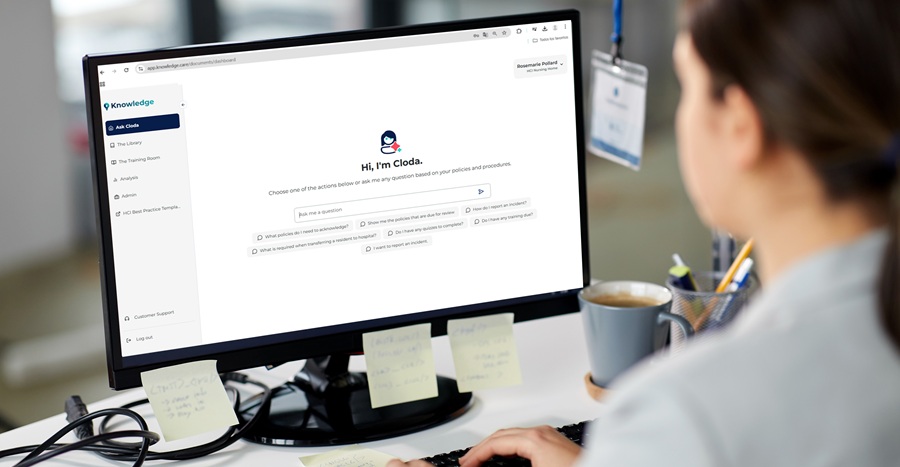
Cloda goes beyond typical policy management software by acting as an AI-powered digital assistant built directly on an organisation’s approved policies and procedures, rather than a static document library staff have to search manually.
Where conventional policy management systems store and version-control documents, Cloda adds three layers on top:
- Real-time, natural-language answers.
Instead of searching through folders or scrolling long documents, staff can ask Cloda a direct question — “When do I escalate a safeguarding concern?”, “What are the steps after an unwitnessed fall?” — and receive an answer generated from the organisation’s own approved policies in seconds, guiding them to the relevant procedure and supporting consistency across roles, shifts and locations.
- Own-language support for diverse teams.
Over 51% of nurses in Ireland are internationally trained, bringing valuable perspective and cultural competence to services. But most policy documentation is written in English, at a level of fluency that doesn’t always reflect the frontline reality. Cloda lets staff access guidance in their own language, reducing misunderstanding and supporting more consistent practice across a diverse workforce.
- Comprehension checks, not just acknowledgement.
Cloda can reinforce key policies with short comprehension quizzes before sign-off, moving organisations from “read acknowledgement” to demonstrated understanding. This supports safer practice on high-risk processes, faster identification of knowledge gaps, stronger evidence that staff understood an update rather than simply received it, and can also serve as a corrective or preventative action following an incident.
Our data shows that on average staff spend just 3 seconds acknowledging a procedure, however when a quiz is added this increases to 2.8 minutes, supporting active engagement and understanding of procedures.
How Do You Keep Healthcare Policies Current?
Keeping healthcare policies current depends on dedicated review resource, visible version history, and automated review-date tracking — not on ad hoc updates triggered by an inspection.
- Dedicated review resource. Someone — internal or external — needs to be actively researching national standards, regulatory updates and best practice guidance on an ongoing basis, rather than reviewing policies reactively once every few years.
- Visible version history. Staff should be able to see when a document was last updated and what changed, not just that a newer version exists.
- Review-date tracking built into the system, so documents are flagged for review automatically rather than relying on someone remembering. With Cloda, managers can actively see policies that are due for review, overdue or will be due within the next 90 days.
How Do You Make Healthcare Policies Genuinely Accessible?
Making healthcare policies genuinely accessible requires more than storing them centrally — it depends on regular communication, structured training, plain-language documentation, and giving staff a fast way to get an answer at the point of care.
A policy that exists but isn’t read, understood, or found in time isn’t compliant in any meaningful sense. In practice, this relies on:
- Instant, point-of-care access. Staff facing a real situation — an unwitnessed fall, a safeguarding concern, a resident refusing care — need an answer in seconds, not a document to search through after the fact. This is the gap Cloda is built to close: staff simply ask Cloda the question, in their own language if needed, and she draws on the organisation’s approved policies and procedures to give an accurate answer in seconds, directing them to the right procedure without ever having to open a document.
- Regular communication. Use existing channels — newsletters, email alerts, team meetings, notice boards — to flag new or revised policies rather than assuming staff will notice on their own.
- Structured training. Combine practical workshops, webinars and interactive sessions so training is accessible across roles and shift patterns, not just for staff who can attend a single in-person session.
- Clear, centralised documentation. Policies should be written in plain, practical language and held in one organised repository — not scattered across shared drives, printed folders and email attachments.
- Team meeting discussion. Reviewing core policies at team meetings gives staff a chance to ask questions and raise real-world implementation issues, not just receive information passively.
- Acknowledgement visibility. Staff should be able to see their own outstanding acknowledgement workload at a glance, and managers should be able to see it across a department or organisation.
How Do You Make Healthcare Policies Auditable?
Making healthcare policies auditable depends on internal audits against real practice, acknowledgement and comprehension data as evidence, and reporting that managers and inspectors can access on demand. This includes:
- Internal audits against policy content — checking not just that staff know a policy exists, but that they can apply it correctly in practice.
- Acknowledgement and comprehension data as evidence. Being able to show, document by document, who has acknowledged and demonstrably understood each policy turns “we have a policy for that” into provable compliance.
- Staff awareness as a management KPI. Tracking acknowledgement and comprehension rates by department at management meetings surfaces gaps before they become inspection findings, rather than after.
- On-demand reporting for inspectors. When HIQA, CQC or an internal quality team asks for evidence, the organisation should be able to produce it in minutes, not days.
What’s the Best Next Step for Your Organisation?
The best next step is to look honestly at whether your current approach can prove your policies are current, accessible and auditable — not just whether the policies exist. Most health and social care providers already have well-written policies and procedures. What determines whether they hold up under inspection, and whether they actually shape day-to-day practice, is what happens after approval: how quickly staff can find the right answer, whether they genuinely understand what they’ve acknowledged, and whether a manager can produce evidence of all of it in minutes rather than days.
That’s the gap policy management software is built to close — and it’s the gap Cloda is built to close further, by turning static policies into instant, point-of-care answers and measurable staff understanding, in every language your team works in.
See Cloda in Action
If you’re ready to move beyond static policy folders and acknowledgement checklists, book a demo and see how Cloda works with your own policies and procedures.
For more information or a demo of Cloda, contact info@cloda.ai or call 01 629 2559.
Frequently Asked Questions
What is the best policy management software for healthcare? The best system for a health and social care provider combines user friendly, easy access to procedures with automatic version control, staff acknowledgement and comprehension tracking, and audit-ready reporting — while keeping the underlying content itself current against evolving national standards. The strongest solutions, such as Cloda, go further still, using AI to give staff instant, natural-language answers from approved policies at the point of care, rather than requiring them to search a document library manually.
What’s the difference between a policy and a procedure? A policy is a written statement of an organisation’s position on a given subject. A procedure is the written, step-by-step instructions for how that policy is carried out in practice. Both need to be documented, current and accessible to staff.
How often should healthcare policies be reviewed? This varies by policy type and regulatory requirement, but best practice is a defined, scheduled review cycle with automatic alerts before a policy’s review date lapses — rather than ad hoc or reactive reviews triggered by an inspection.
Why isn’t a shared drive or printed policy folder enough? Shared drives and printed folders can’t reliably guarantee staff are viewing the current version, can’t confirm staff have understood a document, and can’t produce structured audit evidence on demand. Dedicated, AI-enhanced policy management software solves all three.
How does policy management software help with HIQA or CQC inspections? It provides instant, structured evidence — acknowledgement and comprehension records, version histories, and review dates — that inspectors can review directly, replacing the manual document-gathering that typically happens under inspection pressure.
What makes Cloda different from a standard policy management system? Cloda functions as an AI digital assistant built on an organisation’s approved policies, allowing staff to ask care questions in natural language — including their own language — and receive instant, accurate answers, alongside comprehension quizzes that verify genuine understanding rather than simple acknowledgement.

Book a Demo (1)
"*" indicates required fields