




Introduction
HCI recently hosted a webinar analysing 15 HIQA inspection reports of designated centres for older people, covering inspections completed between October 2025 and March 2026. Presented by Oonagh Gilvarry, Chief Research Officer, and Rebecca McAuley, Best Practice Specialist, the session unpacked the patterns emerging from these reports.
Before we dive in, we would love to hear your thoughts below!
Poll: What’s the biggest obstacle to ensuring staff comply with policies and procedures in your organisation?
Cast your vote and see what your peers say!
The Context: A Sector Under Closer Scrutiny
As noted in HIQA’s Annual Report, 2025 marked a significant shift in the regulatory landscape for nursing homes. Amendments to the Health Act 2007 (Care and Welfare of Residents in Designated Centres for Older People) Regulations 2013 came into effect from 31 March 2025, strengthening provider requirements and giving new powers to the Chief Inspector. Safeguarding-focused inspections also commenced during 2025, with findings highlighting gaps in training and surveillance systems.
With 95% of inspections unannounced and 151 centres receiving two or more inspections in 2025 alone, the message is clear: providers need to be inspection ready at any time.
Six Red Flags Appearing Across Inspections
Our analysis identified six regulations consistently rated as non-compliant — and rated red, meaning high risk — across the 15 reports reviewed.
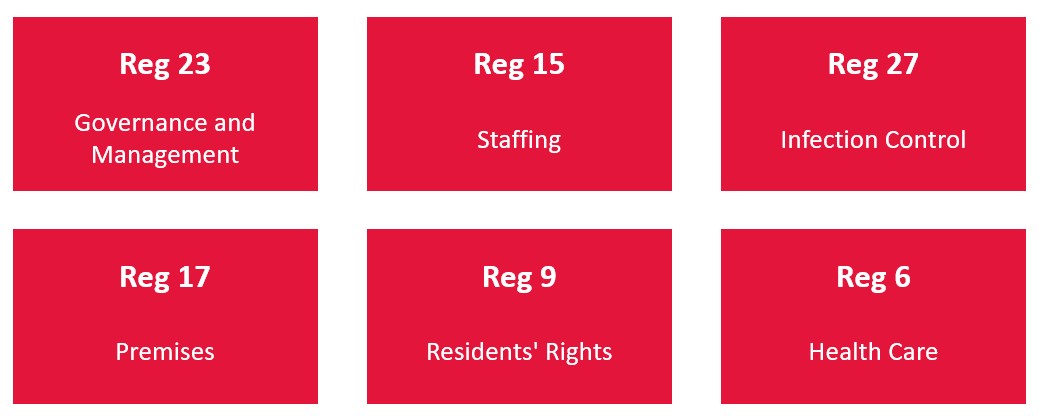
Regulation 23 — Governance and Management
Of all six red-rated areas, this was the most recurring. The core issue wasn’t a lack of audit activity — it was that audits were happening, and nothing was changing as a result. Inspectors found the same gap repeating across reports: systems in place on paper, and evidence of failure on the ground.
- Audits completed but findings not acted upon, with clear disparities between audit results and what inspectors observed on the day.
- No time-bound action plans; actions from previous compliance plans left unimplemented.
- A falls audit that failed to link falls with staffing levels and supervision — and the recommended actions were not evident on inspection day.
- A wound care audit that identified the need for staff to follow dressing regimes, with no evidence of follow-through.
- An annual quality and safety review completed with no quality improvement plan for the following year and no measurable improvement targets set.
- Audits indicating full compliance with residents’ privacy and dignity, directly contradicted by the absence of privacy screens in multi-occupancy bedrooms.
- Staff not informed of low compliance in audits or areas identified for improvement.
- Safeguarding oversight insufficient — inaccurate safeguarding assessments, no documentation that correct disciplinary processes had been followed following an investigation.
- Learning identified from a serious incident review not implemented; an action plan for increased supervision and manual handling training not adhered to.
Regulation 9 — Residents’ Rights
Inspectors found residents unable to use the toilet in private, unaware they were being observed by CCTV, and signed into contracts that could increase their fees four times in a single year. These are not administrative gaps, they are failures with a direct human impact.
- Residents unable to close the door of their ensuite whilst using the toilet or having a shower.
- CCTV in operation in areas where residents would be expected to have privacy — including day rooms, dining rooms and sitting rooms — with limited signage to inform residents.
- Twin bedrooms without adequate privacy screening; one mobile screen too short to enclose a bed.
- Residents unable to access the only bath in the centre without requesting a key from staff.
- Staff placing clothes protectors on residents during mealtimes without seeking consent.
- Residents wishing to access the garden required to walk through the smoking facility, with no alternative route available.
- Independent advocacy service information not available to residents across the centre.
- Residents’ guide and complaints procedure information recorded as “not applicable” in admission records, despite being a regulatory requirement.
- Contract terms with the potential to impose unfair conditions — one provider reserved the right to increase accommodation charges up to four times in any 12-month period.
- Areas for improvement identified by residents not addressed.
Regulation 27 — Infection Prevention and Control
IPC findings were among the most serious in the dataset. What made them particularly concerning wasn’t just individual lapses — it was the evidence that outbreak management systems had failed entirely, and that in some centres, the same problems had surfaced before without being resolved.
- Ineffective management systems contributed directly to IPC failures; poor outbreak communication and oversight meant risks were not identified or escalated in a timely manner.
- One centre experienced three significant outbreaks of infection in the previous five months.
- A deep clean had not been completed following a norovirus outbreak; cleaning records showed cleaning was not enhanced sufficiently during that outbreak.
- No visitor signage in place to alert that the centre was in an outbreak; staff on night duty were not aware the centre was in an outbreak.
- Housekeeping hours not increased to support enhanced cleaning during an active outbreak.
- Monthly IPC audits indicating compliance, directly contradicted by inspection findings of visibly dirty areas.
- Cleaning records for some toilets not updated in five months at the time of inspection.
- Soiled and infected linen not placed in red soluble bags, posing a risk to laundry staff.
- Needles lacking safety devices; sharps boxes not signed, dated or correctly closed, increasing the risk of needle-stick injuries.
- No clinical hand wash basins available in all resident areas.
- An ARI outbreak that went undetected because antimicrobial consumption data was not being routinely analysed for trends.
- Poor vaccination uptake for both residents and staff identified as a contributing factor to infectious outbreaks.

Regulation 15 — Staffing
Staffing findings in these reports went well beyond gaps on a roster. Inspectors observed the direct impact on residents when staffing levels and supervision systems weren’t working — and in some cases, found that providers were making decisions that actively compounded the problem.
- One nurse and one care assistant on duty for 28 residents during night shift.
- Three full-time HCA vacancies and one full-time nursing vacancy at the time of inspection.
- A provider continuing to admit residents despite insufficient staffing levels, placing additional workload on an already reduced staff resource.
- 20 care hours unfilled due to unplanned leave, with poor management of absence.
- No schedule of staff meetings; staff not informed of audit findings or areas for improvement.
- Residents waiting over 30 minutes to be assisted to bed.
- Residents observed without access to their call bells.
- Staffing levels insufficient to provide the increased monitoring required following a safeguarding incident.
- Healthcare assistants assigned enhanced cleaning duties on top of resident care responsibilities during an active outbreak, directly depleting care capacity.
Regulation 6 — Health Care
A care plan is only as good as the care being delivered against it. Inspectors found cases where plans existed, assessments had been completed, and documentation was on file — but the care itself didn’t match. In some instances, the documentation failures meant risks weren’t even visible until an inspector looked closely.
- Care was not delivered in line with resident’s care plan, e.g. the delivery of IPC practices were not aligned to evidenced based guidelines to protect residents from developing HCAIs.
- Nursing documentation and communication did not align with best practice guidelines.
- Oversight of clinical documentation insufficient, incomplete records of fluid intake for residents who required monitoring.
Regulation 17 — Premises
Premises findings are often visible the moment an inspector walks through the door. But these reports show that the risks go beyond appearance — worn surfaces, broken equipment and poor storage arrangements were creating direct infection control and safety risks for residents and staff.
- Laundry dryers not commissioned, resulting in inappropriate transfer of laundry through the building and a risk of cross-infection.
- Oven in the kitchen out of order for an extended period.
- Décor with significant signs of wear and tear — wall paintwork, floor coverings and wood finishes worn and not facilitating effective cleaning.
- Shower tray design encouraging the accumulation of dirt and biofilm.
- Garden path uneven, meaning residents could not walk safely in this area.
- Cleaning chemicals stored inappropriately in the manager’s office alongside other equipment.
- Zimmer frames, linen skips and wheelchairs stored inappropriately in assisted bathrooms.
- Inadequate storage for residents’ personal belongings.
The Pattern Behind the Findings
What connects these six areas is not a lack of policies or systems, it is the gap between what is written and what is happening in practice. Audits indicated compliance that inspectors directly contradicted. Policies existed but were not being followed. Action plans were in place but not implemented. Staff were completing tasks without the knowledge or supervision to do them safely.
This is a systems problem as much as an operational one. And it won’t be solved by updating a folder of documents.
How Cloda Supports Compliance
The findings in these reports describe a very specific problem: the distance between a policy and a staff member who knows what it says, understands what it means, and applies it correctly on the floor.
Cloda is built to close that distance. With 70+ best practice policy and procedure templates for nursing homes, kept current by HCI’s Best Practice Team, Cloda gives staff instant access to the answers they need from your own policies, whether that’s how to manage an infection outbreak, what to do before transferring a resident to hospital, or which policies are due for review.
Comprehension quizzes confirm genuine understanding, not just acknowledgements. And when HIQA asks whether your staff know what your policies say, you’ll have the evidence to show they do.
The gap these inspectors keep finding is closeable. Cloda is how providers are closing it.
For more information or a demo of Cloda, contact info@cloda.ai or call 01 629 2559.
Watch the Full Webinar
The full recording of HIQA’s Red Flags for Nursing Homes: Patterns From The Latest Inspections is now available.

Book a Demo (1)
"*" indicates required fields