


Effective healthcare risk management is essential for protecting patients, supporting staff and strengthening organisational governance. However, many healthcare and social care organisations still rely on manual processes, disconnected spreadsheets and inconsistent reporting systems to identify and manage risks.
These traditional approaches can make it difficult to recognise emerging threats, assess existing controls and respond before risks develop into incidents. When information is fragmented across departments or services, healthcare leaders may lack the visibility needed to take preventative action.
Artificial intelligence (AI) offers an opportunity to strengthen proactive healthcare risk management. By helping organisations identify relevant controls, streamline risk assessments and centralise risk information, AI can support more informed decision-making while reducing administrative workloads.
For healthcare organisations in Ireland, the UK and Australia, combining AI-enabled risk management software with clear governance processes can support earlier intervention, stronger accountability and continuous quality improvement.
Poll: What's the biggest challenge in keeping your risk register up to date?
What Are the Challenges of Traditional Healthcare Risk Management?
Traditional healthcare risk management often relies on fragmented systems and manual processes that delay risk identification and limit oversight.
Many healthcare organisations manage risks using spreadsheets, departmental registers and manual assessment forms. Although these methods provide a basic structure for recording concerns, they can make it difficult to maintain a consistent and accurate view of organisational risks.
When staff identify potential hazards, complicated reporting processes may discourage early reporting or delay information reaching the appropriate manager. Risk assessments can also require considerable administrative effort, particularly when managers must search through multiple systems to identify relevant policies, training records and existing preventative controls.
For healthcare leaders, these challenges can result in:
- Limited organisational visibility: Risks recorded across different departments or services may be difficult to monitor collectively.
- Delayed risk identification: Potential threats may not receive attention until an incident occurs.
- Inconsistent assessments: Different teams may use varying approaches to risk ratings and control measures.
- Administrative inefficiencies: Risk owners spend valuable time locating supporting evidence and updating records.
- Reduced accountability: Outstanding preventative actions may be difficult to assign, monitor and follow up.
These limitations highlight the importance of moving towards a more connected and proactive approach to healthcare risk management, particularly given the governance and risk management gaps identified in HIQA safeguarding inspections of disability services.
How Can Healthcare Organisations Move from Reactive to Proactive Risk Management?
Proactive healthcare risk management identifies potential threats early, evaluates existing safeguards and assigns preventative actions before harm occurs.
Reactive risk management focuses primarily on responding after an incident or failure. While incident investigation remains essential, healthcare organisations also need processes that encourage staff to recognise and report potential risks before they escalate.
A proactive approach involves making risk reporting accessible to frontline teams, ensuring concerns reach the appropriate risk owners and regularly reviewing whether existing control measures remain effective.
For example, a care organisation may identify a potential medication storage risk during a routine operational review. Rather than waiting for an incident, the service manager can assess the concern, review existing medication management procedures and introduce additional safeguards where necessary.
By embedding these preventative activities into everyday operations, healthcare providers can strengthen their approach to risk management and quality improvement.
The objective is not to eliminate every possible risk, but to ensure risks are identified, assessed, monitored and managed through consistent organisational processes.
How Can AI Support Healthcare Risk Assessments?
AI supports healthcare risk assessments by identifying potentially relevant existing controls and presenting evidence for risk owners to review.
One of the most time-consuming elements of healthcare risk assessment is identifying the control measures an organisation already has in place.
When a risk is reported, managers may need to review policies, staff training records, previous audits and other quality documentation before determining whether existing safeguards are sufficient.
AI-powered healthcare risk management software can help streamline this process by analysing relevant organisational information and suggesting potential existing controls.
For example, Cloda’s Risk Management software can review relevant organisational policies, training records and internal audits to suggest existing control measures. Risk owners to review the information before deciding whether each control is appropriate.
This approach provides several operational benefits:
- Reduces time spent manually searching for existing controls.
- Connects risk assessments with relevant organisational documentation.
- Supports more consistent identification of potential safeguards.
- Helps risk owners access supporting evidence during assessments.
- Allows managers to focus more attention on evaluating risks and identifying necessary preventative actions.
Importantly, AI does not independently determine whether a risk is acceptable, or which controls must be implemented. These decisions remain the responsibility of appropriately qualified risk owners.
Why Is a Centralised Healthcare Risk Register Important?
A centralised healthcare risk register improves visibility, standardises assessments and helps managers track risk ownership and preventative actions.
A healthcare risk register provides a structured record of identified risks, including their severity, existing controls, responsible owners and required follow-up actions.
When risk information is distributed across spreadsheets or separate departmental systems, healthcare leaders may struggle to understand their organisation’s overall risk profile.
Centralising this information within a digital risk management system helps managers monitor risks consistently across teams, departments and services.
A centralised register can also strengthen accountability. If a risk assessment identifies insufficient control measures, managers can assign additional preventative actions to specific staff members, set target completion dates and monitor progress.

Manual vs Digital Risk Management in Healthcare
| Risk Management Activity | Manual Approach | Digital Approach |
|---|---|---|
| Risk identification | Manual forms and disconnected reporting processes | Accessible digital risk reporting |
| Risk registers | Separate spreadsheets or departmental records | Centralised organisational risk register |
| Identifying existing controls | Manual review of policies and other documentation | AI suggests potential existing controls based on organisational evidence |
| Risk assessments | Time-consuming manual processes | Structured assessments supported by relevant information |
| Action management | Emails, spreadsheets and manual follow-ups | Assigned actions with clear responsibilities and deadlines |
| Governance oversight | Periodic reporting and fragmented information | More accessible risk information and progress monitoring |
| Quality improvement | Follow-up may be disconnected from risk assessments | Risk findings linked to preventative and improvement actions |
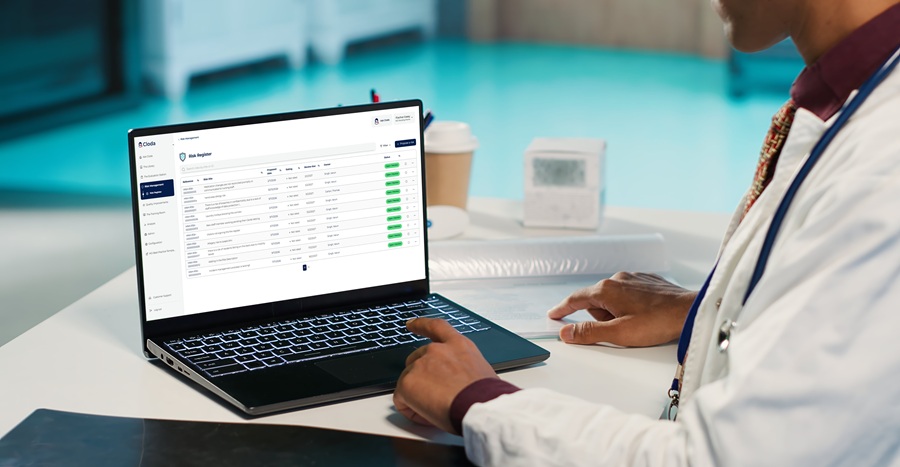
A digital risk register gives healthcare teams one place to record risks, document assessments and track actions. When reviewing a risk, the risk owner can use AI-generated suggestions to identify potential existing controls and verify which ones are in place.
How Can AI Strengthen Healthcare Governance and Risk Accountability?
AI can strengthen healthcare governance by improving access to risk evidence, supporting consistent assessments and making outstanding actions easier to monitor.
Effective risk management depends on more than identifying hazards. Organisations must also demonstrate that identified risks have been appropriately assessed, assigned to accountable individuals and reviewed as circumstances change.
AI-enabled systems can support these responsibilities by making relevant information easier to access and helping managers identify where preventative measures may be needed.
However, professional judgement and human accountability must remain central to every assessment. Risk owners are responsible for reviewing suggested controls, determining final risk ratings and deciding whether additional safeguards are required.
Healthcare organisations must also ensure that AI-assisted risk management processes align with their applicable regulatory requirements and internal governance arrangements.
In Ireland, healthcare organisations should consider relevant guidance from the Health Information and Quality Authority (HIQA), including its National Standards, which outline expectations for quality, safety, governance and risk management across relevant health and social care services.
In England, the Care Quality Commission’s (CQC) Regulation 17: Good Governance requires regulated providers to establish effective systems for assessing, monitoring and mitigating risks to the health, safety and welfare of service users and others.
Other parts of the UK have distinct regulatory arrangements, while Australian providers must consider the quality, safety and governance requirements applicable to their sector.
Across these environments, the underlying principle remains consistent: organisations need reliable processes for identifying, evaluating, managing and reviewing risks.
Cloda supports healthcare quality management and policy access, but it does not replace professional judgement, clinical decision-making or organisational governance.
How Does Cloda Support Proactive Healthcare Risk Management?
Cloda supports proactive healthcare risk management by combining accessible risk reporting, AI-assisted control suggestions and structured action tracking.
Cloda is an AI-powered Healthcare Quality Management System designed to help healthcare and social care organisations manage quality, compliance and governance information more effectively.
Cloda’s Risk Management software brings risk identification, assessment and preventative action management into a connected workflow.
Staff can report potential risks through a centralised system, helping organisations capture concerns before they develop into incidents. These risks can then be reviewed by designated risk owners.
When a risk owner begins an assessment, Cloda uses AI to suggest potentially relevant existing controls based on organisational information, including approved policies, training records and audit findings.
The process works alongside other Cloda quality management capabilities:
- The Library: Provides access to approved organisational policies and procedures that may inform existing risk controls.
- The Training Room: Helps organisations deliver and track staff training on policies and procedures that support existing risk controls.
- The Evaluation Station: Supports audit and quality improvement processes, helping organisations identify findings that may require risk assessment or corrective action.
- Risk Management: Supports risk reporting, AI-assisted control suggestions, structured assessments and assigned preventative actions.
- Governance insights: Help managers review risk profiles, monitor outstanding actions and identify areas requiring attention.
Risk owners remain responsible for reviewing AI-generated suggestions, assessing the remaining risk and assigning additional control measures where necessary.
By connecting risk information with organisational policies, staff training, audits and quality improvement activities, Cloda helps teams manage risk and gives managers clearer oversight of outstanding actions.
This approach also encourages frontline participation in identifying potential risks, making proactive risk management a shared organisational responsibility rather than an isolated administrative task.
How Can Healthcare Organisations Improve Risk Management Through Continuous Monitoring?
Continuous monitoring helps healthcare organisations identify changing risks, review the effectiveness of controls and address outstanding actions before they escalate.
Healthcare risk management should be an ongoing process rather than an activity completed only during annual reviews or following incidents.
Risks can change as services expand, staffing arrangements evolve, new procedures are introduced or operational circumstances develop. Organisations therefore need processes that allow managers to monitor risk ratings, assess the effectiveness of existing controls and respond when additional preventative measures become necessary.
Digital risk management software can help by giving leaders a clearer view of identified risks, their current status and outstanding actions.
For multi-site healthcare organisations, this visibility can be particularly valuable. Regional and senior managers can review risk information across services, identify recurring concerns and determine where additional management attention may be required.
Linking risk management with internal audits and Quality Improvement Plans (QIPs) also helps organisations move from identifying problems to implementing measurable improvements. As explored in Why Healthcare Audits Alone Don’t Drive Compliance and What Does, identifying issues is only the first step; assigning responsibility and tracking corrective actions are essential for meaningful improvement.
Cloda supports this connected approach by helping healthcare teams maintain structured risk records, assign preventative actions and monitor progress as part of wider quality management activities.
Conclusion
Proactive healthcare risk management requires early risk identification, clear accountability and consistent monitoring. By combining centralised risk registers with AI-assisted control suggestions, healthcare organisations can streamline assessments and focus more effectively on preventing harm.
Cloda supports this approach by connecting risk reporting, organisational evidence and preventative actions within a structured quality management system.
To explore how Cloda can support your organisation’s risk management processes, request a demo today. Contact info@cloda.ai or call 01 629 2559.
Key Takeaways
- Proactive healthcare risk management focuses on identifying and addressing potential threats before they develop into incidents.
- AI-assisted risk assessments reduce manual administrative work by suggesting relevant existing controls supported by organisational evidence.
- Centralised healthcare risk registers improve visibility, standardise assessments and strengthen accountability for preventative actions.
- Professional judgement remains essential, with risk owners responsible for reviewing AI suggestions, determining risk ratings and approving control measures.
- Cloda supports connected quality management by bringing risk reporting, assessment, policy information and action tracking into a more structured process.
Frequently Asked Questions
What is proactive healthcare risk management?
Proactive healthcare risk management involves identifying, assessing and addressing potential risks before they cause harm or disrupt services. It focuses on early reporting, preventative controls, continuous monitoring and clear organisational accountability.
How does AI improve healthcare risk assessments?
AI can improve healthcare risk assessments by reviewing relevant organisational information and suggesting existing controls that may help manage an identified risk. Risk owners must evaluate these suggestions, determine appropriate risk ratings and decide whether additional measures are required.
What is the purpose of a healthcare risk register?
A healthcare risk register provides a central record of identified risks, including their ratings, existing controls, owners and outstanding actions. It helps healthcare organisations maintain oversight, monitor changes and demonstrate how risks are being managed.
Can AI replace healthcare risk managers?
No, AI cannot replace the professional judgement or accountability of healthcare risk managers. It can support administrative tasks and provide evidence-informed suggestions, but decisions about risk severity, control effectiveness and preventative actions remain with qualified professionals.
Disclaimer: This article was developed with the assistance of AI tools. All content has been verified using source documents. The content has been reviewed and edited by HCI to ensure accuracy and relevance to the specific context.

Book a Demo (1)
"*" indicates required fields